Scottish last names reflect a remarkable mix of Gaelic heritage, geography, occupations, personal names, and centuries of family history. Some are strongly associated with Highland clans, while others originated in the Scottish Lowlands, Borders, islands, or particular estates and villages. You will also find surnames formed from occupations, nicknames, and patronymics—names based on an ancestor’s given name.
This collection of Scottish last names brings together classic, uncommon, strong, and historically interesting surnames, with concise explanations of their meanings and origins. It is useful whether you are researching family history, choosing a surname for a character, looking for a distinctive family name, or simply exploring Scottish naming traditions.
One important distinction is worth remembering: having a surname associated with a Scottish clan does not automatically prove descent from that clan’s chief or principal family. Historically, clan communities included followers who could adopt a clan name for protection, loyalty, or other social reasons.
What Makes a Scottish Last Name?
Scottish surnames developed from several naming traditions. Common sources include occupations, places, descriptions, and patronymics based on a father’s or ancestor’s name. Gaelic naming traditions also produced many surnames beginning with Mac or Mc, with Mac traditionally meaning “son of.”
Scottish surnames can therefore tell very different kinds of stories. A name such as Stewart reflects an occupation, while Anderson means “son of Andrew.” Others, such as Blair and Ross, connect to landscape or place names. MacKenzie and MacIntyre preserve Gaelic patronymic forms.
The list below focuses on surnames that are recognizably Scottish or have substantial Scottish historical usage. Meanings are kept deliberately cautious where etymology is uncertain.
Popular Scottish Last Names
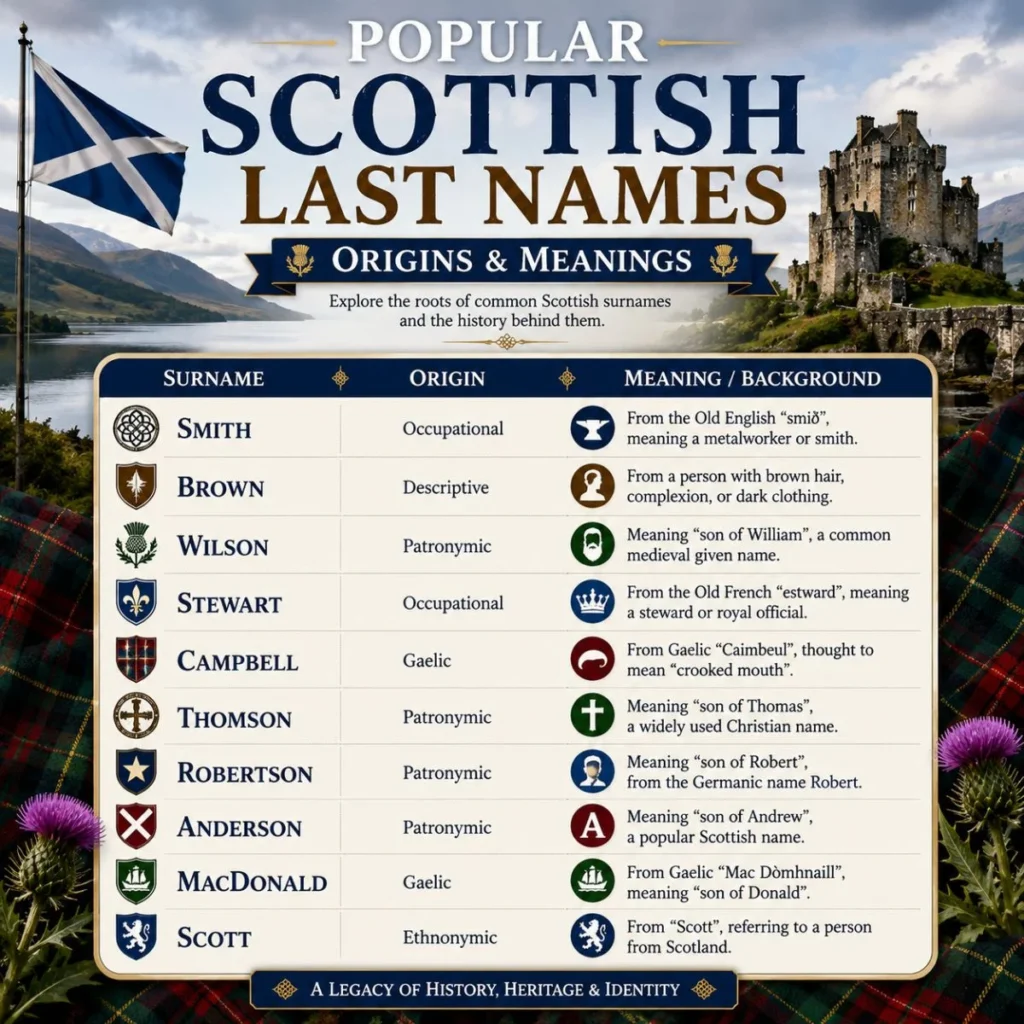
These familiar surnames are among the names most strongly associated with Scotland. Some are widespread beyond Scotland today, but each has an established Scottish connection.
- Smith — An occupational surname for a metalworker or smith.
- Brown — A descriptive surname associated with brown coloring or complexion.
- Wilson — A patronymic surname meaning “son of William.”
- Stewart — An occupational surname associated with a steward or administrator of an estate; it later became closely connected with Scotland’s royal House of Stewart.
- Campbell — From Gaelic Caimbeul, traditionally interpreted as “crooked mouth.”
- Thomson — A patronymic form meaning “son of Thomas.”
- Robertson — Meaning “son of Robert.”
- Anderson — Meaning “son of Andrew.”
- MacDonald — From Gaelic Mac Dòmhnaill, meaning “son of Donald.”
- Scott — An ethnonymic surname referring to a Scot or person associated with Scotland.
- Reid — Traditionally associated with “red,” often interpreted as a nickname for someone with red hair or a ruddy complexion.
- Murray — A surname associated with the region of Moray in northern Scotland.
- Taylor — An occupational surname for a tailor.
- Clark — An occupational surname connected with a clerk or cleric.
- Ross — A territorial surname associated with Ross in the Scottish Highlands.
- Watson — A patronymic surname meaning “son of Walter.”
- Morrison — A patronymic surname meaning “son of Morris”; Scottish Gaelic traditions also produced related forms.
- Paterson — Meaning “son of Patrick.”
- Fraser — A long-established Scottish surname associated with Clan Fraser.
- Gordon — A territorial surname associated with Gordon in the Scottish Borders.
- Graham — A historic Scottish surname associated with the Graham family and several important Scottish branches.
- Hamilton — A territorial surname associated with Hamilton in Lanarkshire.
- Johnston — A territorial surname meaning roughly “John’s town.”
- Cameron — A Scottish surname with both Highland clan and separate Lowland territorial traditions.
Scottish Last Names With Meanings
If the meaning matters as much as the sound, these surnames offer a useful starting point. Some meanings are straightforward, while others come from old Gaelic, English, Norse, or place-name elements.
- Armstrong — Traditionally interpreted as a nickname meaning “strong arm.”
- Baird — Associated with the Gaelic bàrd, meaning “bard” or poet.
- Blair — From Gaelic blàr, associated with a plain or battlefield.
- Blackwood — A territorial name referring to a place or landscape of black/dark woodland.
- Burns — Derived from an old word for a stream or small river.
- Cockburn — A territorial surname from Cockburn in Berwickshire.
- Douglas — From a place name traditionally interpreted using Gaelic elements associated with “dark” and “stream.”
- Forbes — An old Scottish surname associated with the Forbes lands in Aberdeenshire.
- Grant — A prominent Scottish surname whose etymology has more than one proposed explanation.
- Hunter — An occupational surname for a hunter.
- Kerr — A Border surname traditionally associated with a place or landscape name.
- MacIntyre — From Gaelic Mac an tSaoir, meaning “son of the carpenter.”
- MacIntosh — From Gaelic Mac an Tòisich, meaning “son of the chief.”
- MacKenzie — From Gaelic MacCoinnich, meaning “son of Coinneach.”
- MacKay — An anglicized form of Gaelic MacAoidh.
- MacLeod — From Gaelic Mac Leòid, meaning “son of Leod.”
- MacMillan — An anglicized form connected with Gaelic MacMhaolain.
- McInnes — An anglicized form of Gaelic Mac Aonghais, meaning “son of Angus.”
- McIver — An anglicized form of Gaelic Mac Iomhair, meaning “son of Ivar/Iomhar.”
- McKellar — From Gaelic MacEalair.
- McKendrick — An anglicized Gaelic patronymic form meaning “son of Eanraig.”
- McLean — A Scottish surname with Gaelic origins and long Highland associations.
- McRae — A Scottish surname derived from a Gaelic personal-name tradition.
- Stevenson — Meaning “son of Steven.”
- Thomson — Meaning “son of Thomas.”
- Wallace — Historically associated with the Anglo-Norman/Old French term waleis, referring to a Welshman or Briton.
- Watson — Meaning “son of Walter.”
Scottish Highland Last Names
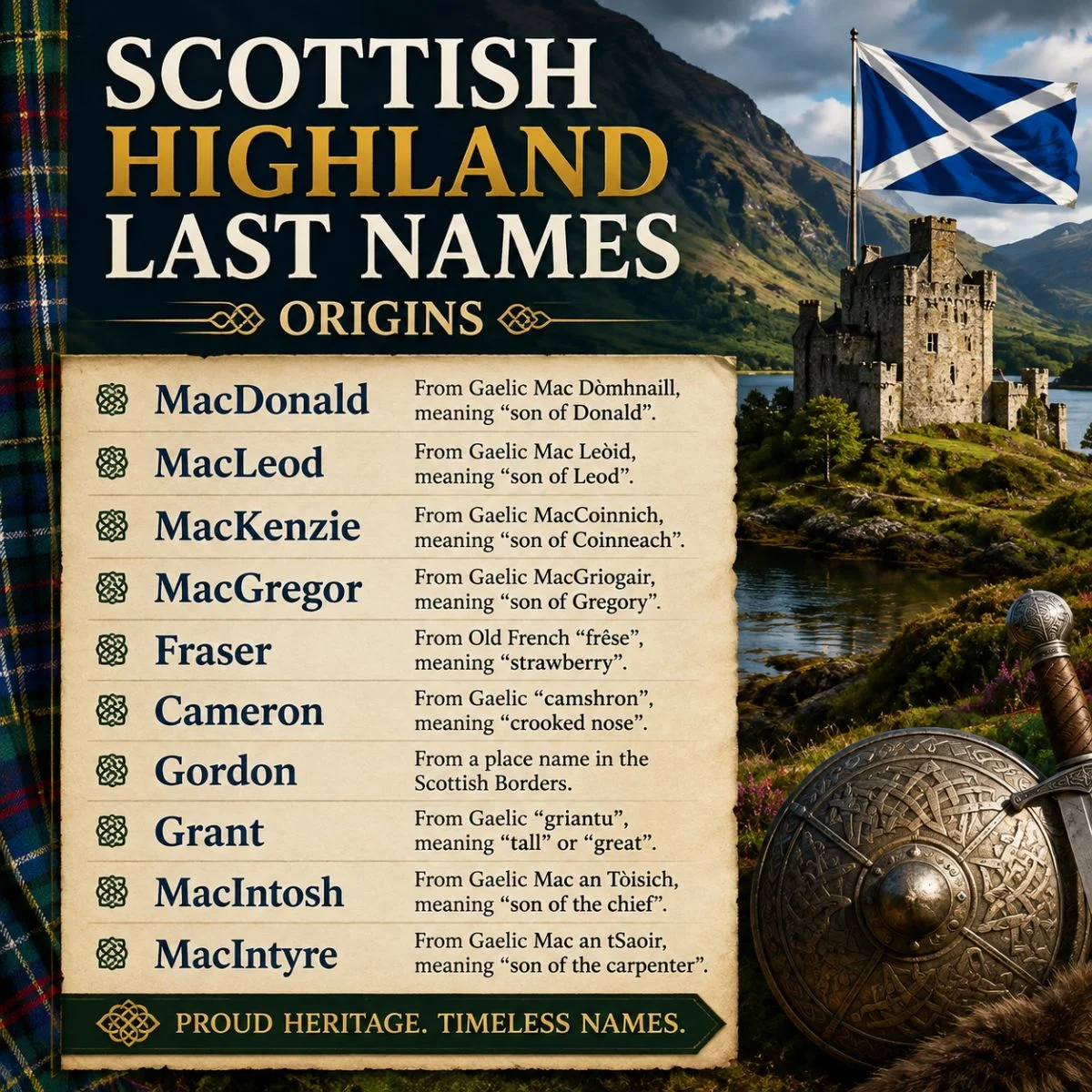
Highland surnames often have strong Gaelic connections and are frequently associated with historic clan communities. However, a surname-clan connection should be treated as a historical association rather than automatic evidence of ancestry.
- MacDonald — One of the best-known Highland-associated surnames.
- MacLeod — A historic Gaelic surname strongly associated with the Isle of Skye and the Outer Hebrides.
- MacKenzie — Associated historically with Kintail and the northwest Highlands.
- MacLean — A long-established Highland and Hebridean surname.
- MacKay — Historically connected with the far north of Scotland.
- MacGregor — A historic Highland surname with a complicated history of prohibition and restoration.
- MacIntosh — A Gaelic surname meaning “son of the chief.”
- MacIntyre — A Gaelic occupational patronymic meaning “son of the carpenter.”
- MacRae — Traditionally associated with the Highlands, particularly Kintail.
- Cameron — Associated with the Highland clan tradition as well as separate Lowland origins.
- Fraser — A major Scottish surname with Highland branches.
- Gordon — Associated with a powerful historic Scottish family and northern Scotland.
- Grant — A major surname with long Highland associations.
- Munro — A Scottish Highland surname associated particularly with Ross-shire.
- Mackenzie — A common spelling variant of MacKenzie.
- McLeod — A common anglicized spelling of MacLeod.
- McLean — A common spelling variant of MacLean.
- McRae — A spelling variant of MacRae.
- McKay — An anglicized spelling of MacKay.
- McIntyre — An anglicized form of MacIntyre.
Scottish Lowland and Border Last Names
Not every Scottish surname comes from the Highlands. The Lowlands and Borders developed their own rich surname traditions, with many names deriving from places, occupations, nicknames, and families connected to the border region.
- Armstrong — Strongly associated with the historic Scottish Borders.
- Bell — A longstanding surname found in the Borders and elsewhere.
- Burns — A surname with broad Scottish use and a strong literary association through Robert Burns.
- Douglas — A historic Lowland surname associated with powerful medieval families.
- Hamilton — Connected with Hamilton in Lanarkshire.
- Johnston — Historically associated with the Scottish Borders.
- Kerr — A prominent Border surname.
- Ramsay — A long-established Scottish surname associated with the Lowlands and Borders.
- Scott — Particularly associated with the Scottish Borders and the historic Clan Scott.
- Turnbull — A traditional Border surname.
- Cunningham — Associated with Cunningham in Ayrshire.
- Dalrymple — A territorial surname associated with Dalrymple in Ayrshire.
- Ferguson — A patronymic surname meaning “son of Fergus.”
- Gibson — A patronymic surname meaning “son of Gib,” a medieval form related to Gilbert.
- Henderson — Meaning “son of Henry” or a related medieval personal-name form.
- Irving — A Scottish surname associated with places and families in the southwest and Borders.
- Laing — A surname derived from a medieval personal-name tradition related to “long.”
- Maxwell — A territorial surname associated with Maxwellton in Dumfriesshire.
- Nicolson — Meaning “son of Nicol/Nicholas.”
- Scott — A classic Border surname with a particularly strong historical connection to the region.
Scottish Clan Surnames
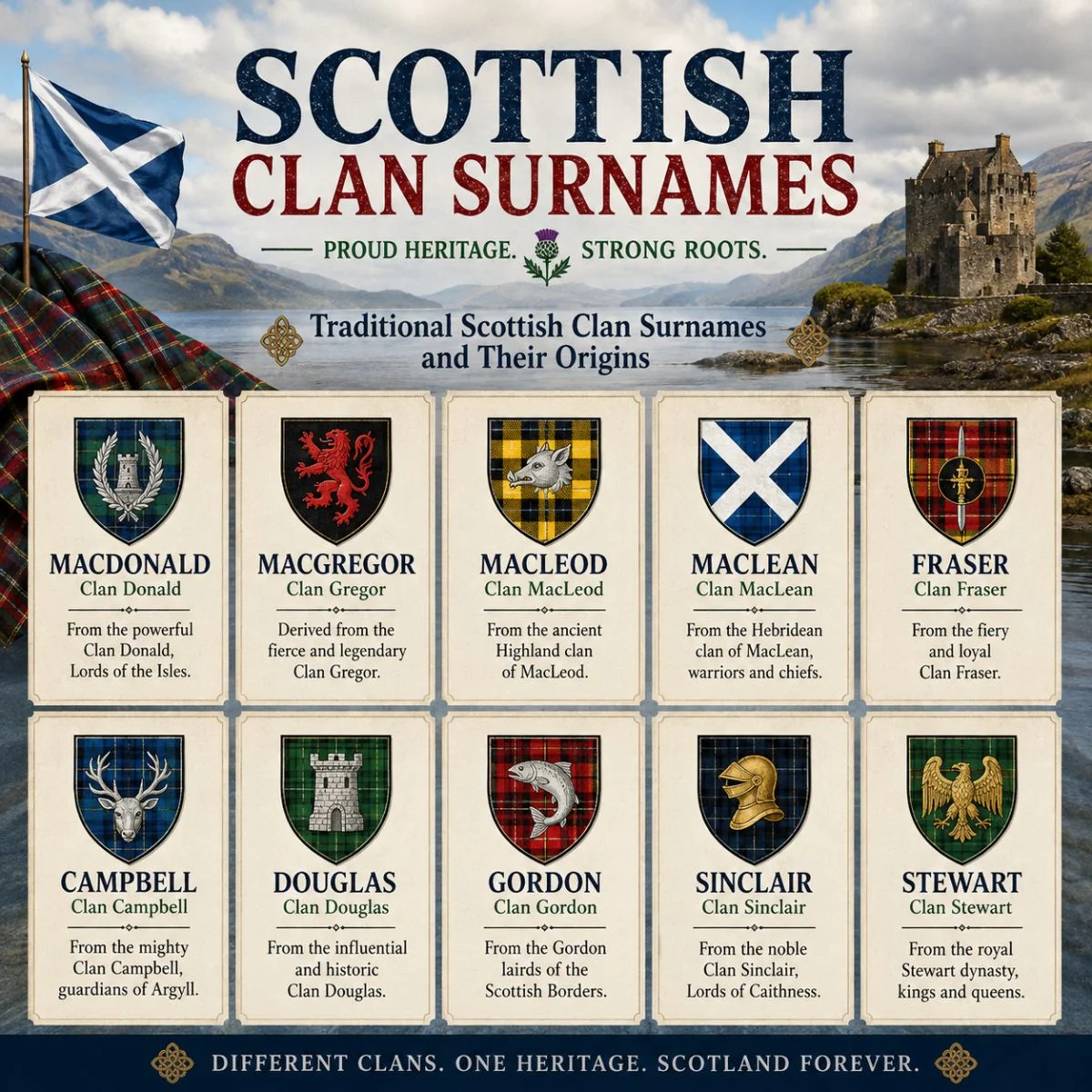
Clan surnames are especially popular among people researching Scottish heritage or creating historically inspired characters. Yet the relationship between a surname and a clan is more complicated than simply matching a family name to a clan name.
Scotland’s official genealogical guidance notes that clan followers could adopt a powerful clan’s name for loyalty, protection, social advantage, or because political circumstances left them little choice. Likewise, not every member of a clan necessarily used the clan’s principal surname.
Some well-known clan-associated surnames include:
- Campbell — Associated with Clan Campbell and Argyll.
- Cameron — Associated with Clan Cameron in the Highlands.
- Campbell — A major historic clan surname with roots in western Scotland.
- Douglas — Associated with one of medieval Scotland’s most influential families.
- Fraser — Associated with Clan Fraser and several Scottish branches.
- Gordon — Associated with Clan Gordon and northern Scotland.
- Grant — Associated with Clan Grant.
- Graham — Associated with Clan Graham.
- Hamilton — Associated with the powerful Hamilton family.
- MacDonald — Associated with Clan Donald.
- MacGregor — Associated with Clan Gregor.
- MacIntosh — Associated with Clan Mackintosh.
- MacKay — Associated with Clan Mackay.
- MacKenzie — Associated with Clan Mackenzie.
- MacLean — Associated with Clan MacLean.
- MacLeod — Associated with Clan MacLeod.
- MacNeill — Associated with Clan MacNeil.
- Murray — Associated with several historic Murray branches.
- Munro — Associated with Clan Munro.
- Robertson — Associated with Clan Robertson, also known historically as Donnachaidh.
- Ross — Associated with Clan Ross.
- Stewart — Associated with the Stewart dynasty and numerous Scottish branches.
- Wallace — Historically associated with the Wallace family and the Borders.
- Menzies — A historic Scottish surname with Highland associations.
Strong Scottish Last Names
For characters, fictional families, fantasy settings, or anyone looking for a surname with a commanding sound, these choices have a particularly solid presence.
- Armstrong — Direct, forceful, and traditionally associated with strength.
- Blackwood — Combines a dark woodland image with a distinctly Scottish feel.
- Campbell — Short, recognizable, and historically powerful.
- Cameron — Familiar without sounding overly formal.
- Douglas — A classic surname with considerable historical weight.
- Ferguson — Strong traditional rhythm and a clear patronymic structure.
- Fraser — Compact and refined while retaining Scottish character.
- Gordon — Traditional, sturdy, and easy to pronounce.
- Graham — Familiar, understated, and versatile.
- Hamilton — Formal and distinguished.
- MacDonald — Bold and immediately recognizable.
- MacGregor — A memorable choice with strong historical associations.
- MacKenzie — Distinctive while remaining familiar.
- MacLeod — Short, sharp, and strongly Scottish in character.
- Maxwell — Polished and substantial.
- Munro — Brief, distinctive, and strongly associated with Scotland.
- Ramsay — Traditional but approachable.
- Stewart — Classic and historically important.
- Wallace — Strongly connected with Scottish history and identity.
- Wilson — Simple, versatile, and widely recognizable.
Rare and Uncommon Scottish Last Names
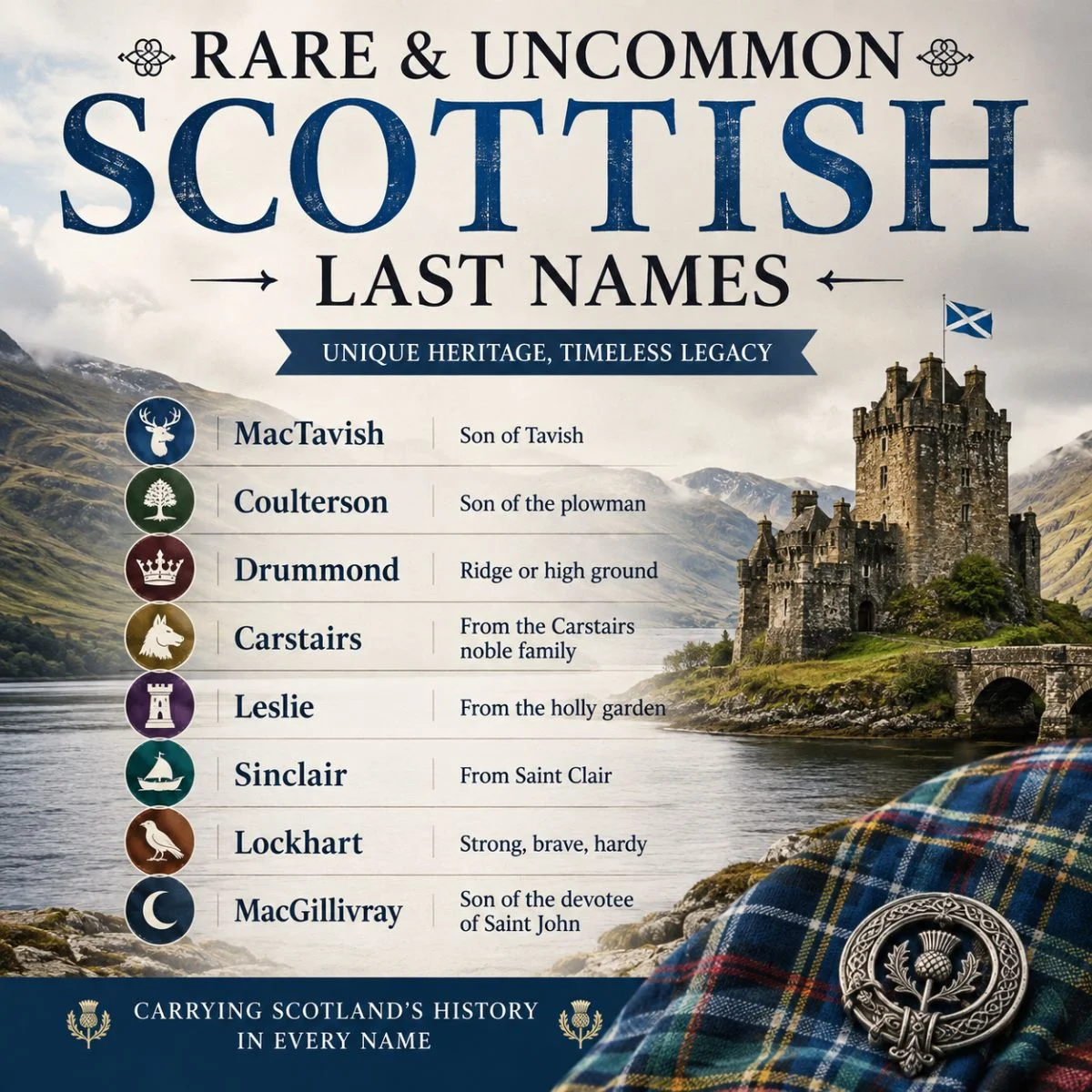
If you want something less familiar, these surnames can offer a more distinctive sound. “Uncommon” here refers to their relative familiarity rather than a claim that each is extremely rare in modern Scotland.
- Abernathy — A territorial surname associated with Abernethy.
- Ainslie — A Scottish surname with territorial roots.
- Aitken — A form derived from the medieval personal name Atkin, related to Adam.
- Balmer — A Scottish surname with Border and Lowland associations.
- Buchanan — A historic Scottish surname associated with Buchanan lands near Loch Lomond.
- Carmichael — A territorial surname associated with Carmichael in Lanarkshire.
- Cunningham — A historic surname associated with Ayrshire.
- Dalzell — A Scottish territorial surname with a long historical record.
- Drummond — A prominent Scottish surname with historic Perthshire associations.
- Erskine — A distinguished Scottish surname associated with Erskine in Renfrewshire.
- Kincaid — A Scottish surname associated with a place in Stirlingshire.
- Kirkpatrick — A surname connected with places named for St Patrick.
- Lennox — A territorial surname associated with the historic district of Lennox.
- MacAskill — A Gaelic surname associated with the Hebrides.
- MacAulay — A Scottish Gaelic surname with several historical forms.
- MacBrayne — A Scottish surname with Gaelic roots.
- MacFarlane — A historic Scottish surname associated with the Lennox region.
- MacNab — A Gaelic surname traditionally interpreted as “son of the abbot.”
- MacNicol — A Scottish Gaelic patronymic surname.
- MacQuarrie — A Gaelic surname associated with the Hebrides.
- MacTavish — A Gaelic patronymic surname meaning “son of Thomas.”
- Sempill — A historic Scottish surname with territorial associations.
- Strachan — A Scottish surname traditionally associated with places in Aberdeenshire and Perthshire.
- Tulloch — A Scottish surname derived from a Gaelic landscape term associated with a hill.
- Wemyss — A territorial surname associated with Wemyss in Fife.
Scottish Last Names Starting With A–F
An alphabetical selection makes it easier to browse when you already have a first name and want a surname that fits.
- Abernathy
- Ainslie
- Aitken
- Allan
- Anderson
- Armstrong
- Baird
- Bannerman
- Barclay
- Bell
- Black
- Blackwood
- Blair
- Boyd
- Brown
- Buchanan
- Burns
- Cameron
- Campbell
- Clark
- Cochran
- Cockburn
- Cunningham
- Dalrymple
- Douglas
- Drummond
- Duncan
- Erskine
- Ferguson
- Forbes
- Fraser
Scottish Last Names Starting With G–M
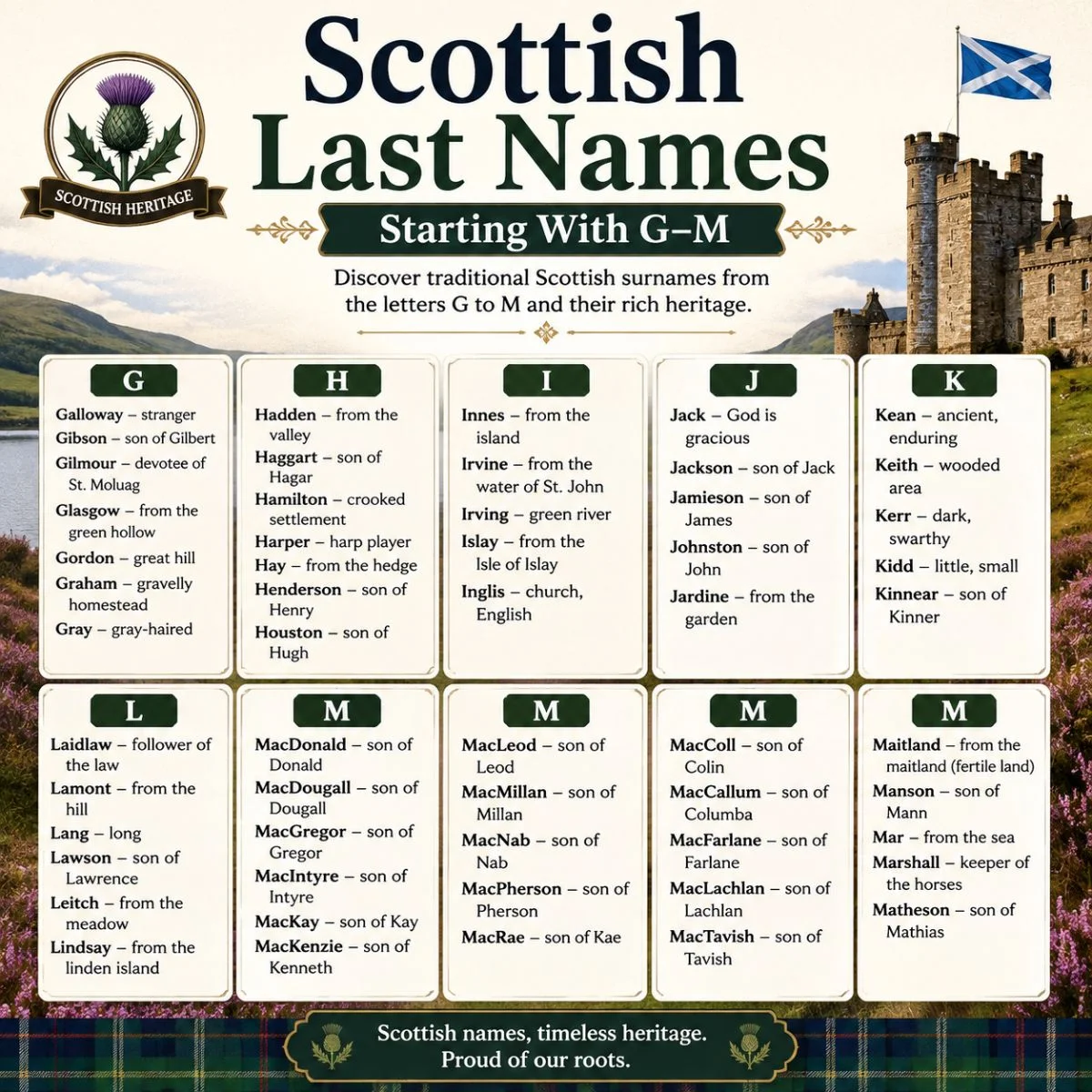
These names range from familiar surnames to more distinctive choices with Gaelic or territorial backgrounds.
- Galloway
- Gibson
- Gordon
- Graham
- Grant
- Gray
- Hamilton
- Henderson
- Hunter
- Innes
- Irving
- Johnston
- Kerr
- Kincaid
- Kirkpatrick
- Laing
- Lennox
- Leslie
- MacAulay
- MacDonald
- MacFarlane
- MacGregor
- MacIntosh
- MacIntyre
- MacKenzie
- MacLean
- MacLeod
- MacMillan
- MacRae
- Maxwell
- Menzies
- Montgomery
- Morrison
- Munro
- Murray
Scottish Last Names Starting With N–Z
For a less predictable surname, the latter part of the alphabet offers plenty of strong traditional options.
- Nicolson
- Paterson
- Ramsay
- Reid
- Robertson
- Ross
- Rutherford
- Scott
- Sinclair
- Simpson
- Stevenson
- Stewart
- Strachan
- Sutherland
- Taylor
- Thomson
- Turnbull
- Wallace
- Watson
- Watt
- Wilson
- Wemyss
- Young
Scottish Last Names for Characters
A good character surname should fit the setting, personality, and social background of the character. A historical Highland character may need a different choice from a modern Edinburgh character, while a fantasy character can borrow Scottish sounds without pretending that every invented name is historically authentic.
For realistic fiction, recognizable surnames usually work better than complicated spellings.
- Cameron — Versatile for a modern or historical character.
- Campbell — Works well for a character with a traditional Scottish background.
- Douglas — Suitable for a serious, established family.
- Fraser — Refined without sounding overly formal.
- Gordon — A dependable choice for many character types.
- Graham — Natural and understated.
- Hamilton — Particularly effective for a formal or aristocratic fictional family.
- MacGregor — Evokes a strong Highland historical atmosphere.
- MacKenzie — Distinctive and recognizable.
- MacLeod — A concise choice with strong Highland associations.
- Maxwell — Suitable for contemporary or historical fiction.
- Munro — Short and memorable.
- Ramsay — Works particularly well for a grounded historical character.
- Sinclair — Elegant and slightly dramatic.
- Stewart — A classic choice with broad historical associations.
- Wallace — Useful when Scottish historical atmosphere is important.
How to Choose the Right Scottish Last Name
The best surname depends on why you need it. A genealogy project calls for historical accuracy, while a fictional character may prioritize sound and personality.
Consider these factors before choosing:
- Check the origin. If historical authenticity matters, verify whether the surname actually has the Scottish connection you want.
- Match the setting. Highland, Lowland, Border, island, and urban Scottish contexts can have different naming traditions.
- Think about pronunciation. A surname that looks beautiful on the page may be difficult for readers to pronounce.
- Consider the first name. Pair a longer first name with a concise surname, or balance a short first name with something more substantial.
- Avoid assuming clan ancestry. A clan-associated surname alone does not establish descent from a particular chief or family line.
- Check spelling variants. Mac, Mc, and other historical spellings can reflect different documentary traditions rather than completely unrelated families.
- Say the full name aloud. This quickly reveals awkward rhythms or difficult combinations.
- Choose meaning carefully. If the surname is intended to symbolize strength, nature, ancestry, or another theme, check the etymology rather than relying on a generic name generator.
Frequently Asked Questions
What are some common Scottish last names?
Some widely recognized Scottish surnames include Smith, Brown, Wilson, Stewart, Campbell, Thomson, Robertson, Anderson, MacDonald, Scott, Reid, Murray, Taylor, and Ross. Scottish surname frequency varies by source and location, so a “common” list should not be treated as a universal ranking.
What does Mac mean in Scottish surnames?
Mac is a Gaelic patronymic prefix traditionally meaning “son of.” Many Scottish Gaelic surnames developed from a personal name followed by Mac, such as MacDonald, MacKenzie, and MacIntyre.
Are Mac and Mc the same?
They can represent related naming traditions, but spelling conventions developed differently over time. A surname written with Mac should not automatically be assumed to have a different family origin from a related Mc form. Historical records contain numerous spelling variations.
Does having a Scottish clan surname mean I belong to that clan?
Not necessarily. Scottish clan membership historically included followers who did not always share a direct blood relationship with the chief’s family. People could adopt clan surnames for protection, allegiance, or social reasons. Therefore, a surname can suggest a historical association without proving ancestry.
What is a good Scottish last name for a character?
It depends on the character. MacLeod, MacKenzie, Campbell, Fraser, Munro, Douglas, Sinclair, Stewart, and Wallace can work well for characters when a recognizable Scottish atmosphere is desired. For historical fiction, however, the character’s region and period should also influence the choice.
Are Scottish last names always Gaelic?
No. Scottish surnames come from several linguistic and cultural sources. They can reflect Gaelic, English, Norse, Norman, and local place-name traditions. Occupational, geographical, descriptive, and patronymic naming all contributed to the surname landscape.
What are some Scottish surnames with strong meanings?
Names such as Armstrong are traditionally connected with physical strength, MacIntyre means “son of the carpenter,” MacIntosh means “son of the chief,” and Anderson means “son of Andrew.” Other surnames derive from places or occupations rather than describing a personality trait.
How can I research my own Scottish surname?
Start with family records such as birth, marriage, death, census, immigration, and land documents. Scotland’s People provides genealogical resources for researching Scottish records, while surname references can help explain possible origins. Most importantly, trace the documented family line rather than assuming ancestry solely from a surname or clan association.
Conclusion
Scottish last names offer much more than distinctive sounds. They preserve traces of Gaelic patronymics, Scottish landscapes, occupations, medieval families, Border communities, and historic clan traditions. Whether you prefer a familiar surname such as Campbell, Stewart, Scott, or MacDonald, or something less common such as Wemyss, MacNab, Kincaid, or Dalrymple, the strongest choice is one that fits your purpose and has an origin you can stand behind.
For character naming, family-history research, or creative inspiration, focus on the surname’s meaning, regional connection, pronunciation, and historical context rather than choosing a name simply because it sounds Scottish. A little research can turn an attractive surname into a much more meaningful one.

James Harrison is a dedicated name researcher and content writer at NamesCabin. He specializes in baby names, usernames, team names, gaming names, pet names, and name meanings. With a passion for language, culture, and creativity, James helps readers discover meaningful and memorable names through well-researched guides and expert insights.