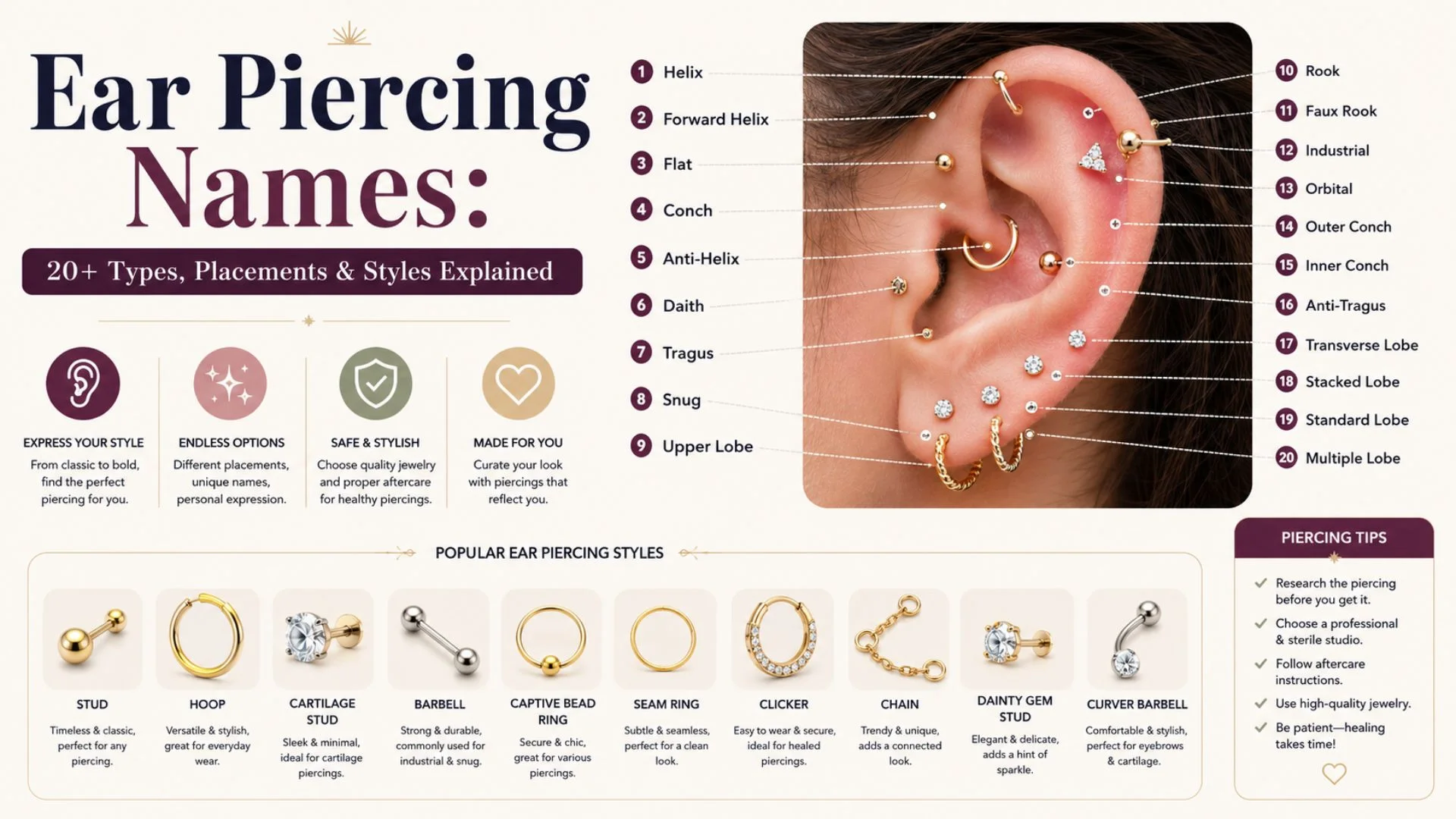
If you are searching for ear piercing names, you may be surprised by how many different placements exist beyond the familiar lobe piercing. Terms such as helix, conch, tragus, rook, daith, and industrial describe specific areas of the ear, and knowing the difference makes it much easier to explain the look you want.
This guide breaks down the most common ear piercing names by location, style, and difficulty. You will find simple descriptions of where each piercing sits, what makes it distinctive, and what type of jewelry commonly suits it. We will also cover popular combinations for a curated ear and practical questions to consider before choosing a placement.
Because every ear has different anatomy, a name or diagram is only a starting point. A professional piercer should assess your ear before deciding whether a particular placement is suitable.
The Most Common Ear Piercing Names
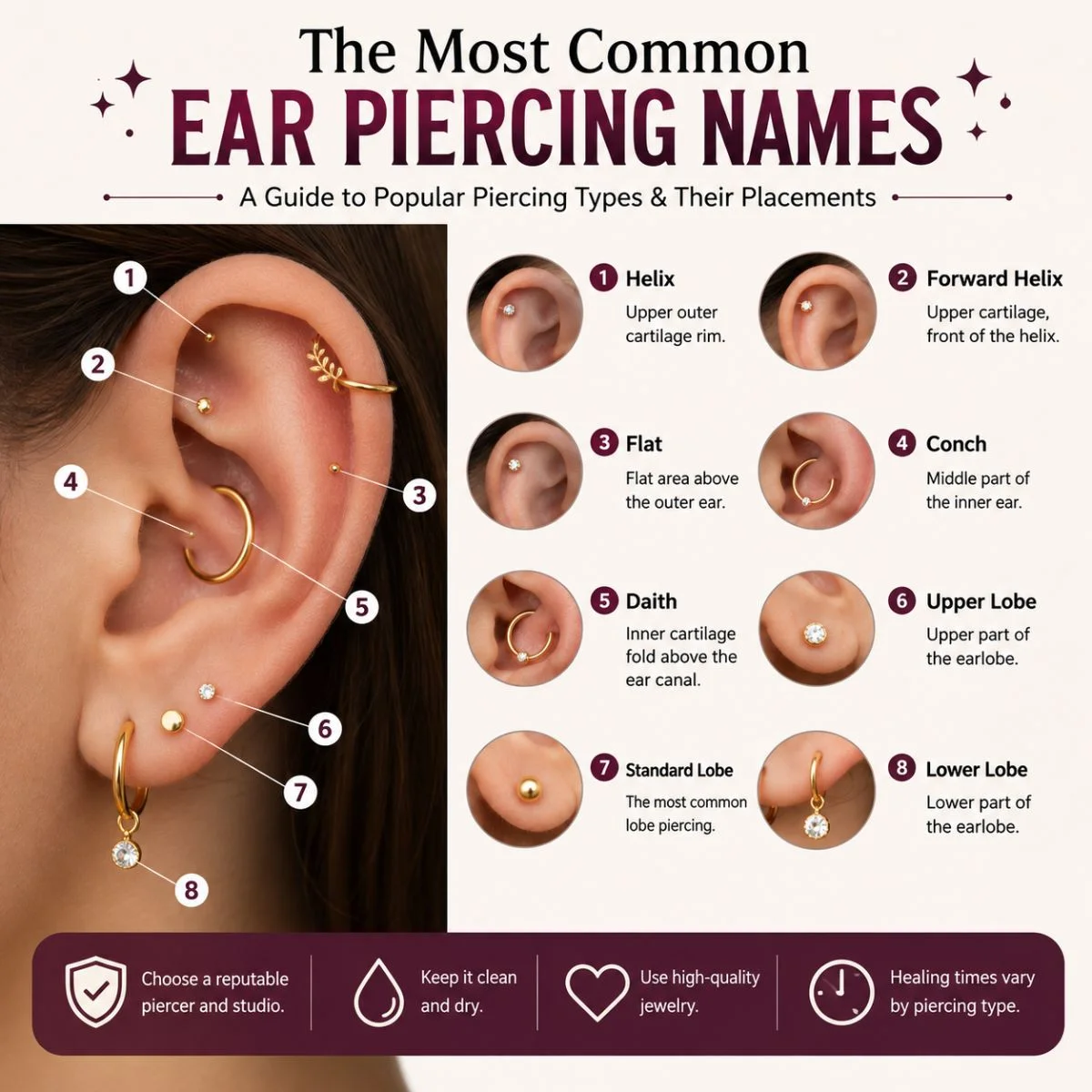
The easiest way to understand ear piercing terminology is to divide the ear into soft lobe tissue and cartilage areas. Lobe placements are generally simpler, while cartilage piercings require more patience during healing.
Here are the main names you are likely to encounter:
- Standard Lobe — The classic piercing through the soft lower part of the earlobe.
- Upper Lobe — Sits higher on the lobe, making it useful for layered earring combinations.
- Stacked Lobe — Several lobe piercings arranged vertically or diagonally for a curated look.
- Helix — A piercing placed through the upper outer cartilage rim.
- Forward Helix — Located on the front section of the upper ear cartilage near the head.
- Flat — Positioned through the flatter upper cartilage area inside the outer rim.
- Auricle — Sits along the outer ear cartilage between the lobe and upper helix.
- Conch — Goes through the bowl-shaped cartilage in the middle of the ear.
- Tragus — Located on the small cartilage flap directly in front of the ear canal.
- Anti-Tragus — Found opposite the tragus, above the upper edge of the lobe.
- Daith — Passes through the small inner cartilage fold above the ear canal.
- Rook — Sits through the inner cartilage ridge above the daith.
- Snug — Runs through the inner cartilage ridge toward the outer edge of the ear.
- Industrial — Uses two piercing channels connected by one barbell, usually across the upper ear.
- Orbital — Two piercing holes connected by a single ring rather than a straight bar.
The exact placement can vary slightly because ear anatomy differs from person to person. That is one reason a professional consultation matters before choosing a specific placement.
Ear Piercing Names by Ear Area
Grouping piercings by location makes the terminology much easier to remember. Instead of memorizing a long list, think of the ear as several styling zones.
Lobe Piercing Names
The lobe is the soft tissue at the bottom of the ear. It offers some of the most familiar placements and works well with studs, hoops, and other lightweight jewelry.
- Standard Lobe — The traditional lower-ear piercing and a common starting point.
- Upper Lobe — A second or higher placement that creates more space for layered jewelry.
- Stacked Lobe — A decorative arrangement of multiple lobe piercings positioned close together.
- Transverse Lobe — A less common placement that travels horizontally through the lobe rather than straight through it.
Lobe piercings are often easier to style because the area accommodates many jewelry shapes. However, suitability still depends on the individual ear and the planned jewelry.
Outer Cartilage Piercing Names
Outer cartilage placements create the recognizable curved-ear look often seen in curated ear styling.
- Helix — One of the most recognizable cartilage piercings, placed along the upper outer rim.
- Forward Helix — Sits toward the front of the upper ear, closer to the head.
- Flat — Located on the relatively flat cartilage surface inside the upper rim.
- Auricle — Positioned along the outer cartilage between the lobe and upper helix.
These placements can look especially elegant with small studs, delicate hoops, or coordinated jewelry. Since cartilage generally heals more slowly than soft lobe tissue, patience is important.
Inner Ear Piercing Names
Inner-ear placements are popular when someone wants a more distinctive look without relying entirely on the outer rim.
- Conch — Located in the bowl-shaped central cartilage of the ear.
- Inner Conch — A placement toward the central bowl of the ear.
- Outer Conch — Positioned closer to the outer portion of the conch area.
- Tragus — Found on the cartilage flap immediately in front of the ear canal.
- Daith — Placed through the innermost cartilage fold above the canal.
- Rook — Pierces the raised inner ridge above the daith.
- Snug — Runs through the cartilage ridge between the outer ear and inner structures.
- Anti-Tragus — Sits opposite the tragus near the upper lobe area.
Not every ear has suitable anatomy for every inner-ear piercing. A reputable piercer should examine the tissue, folds, spacing, and jewelry requirements before recommending one.
Best Ear Piercing Names for a First Piercing
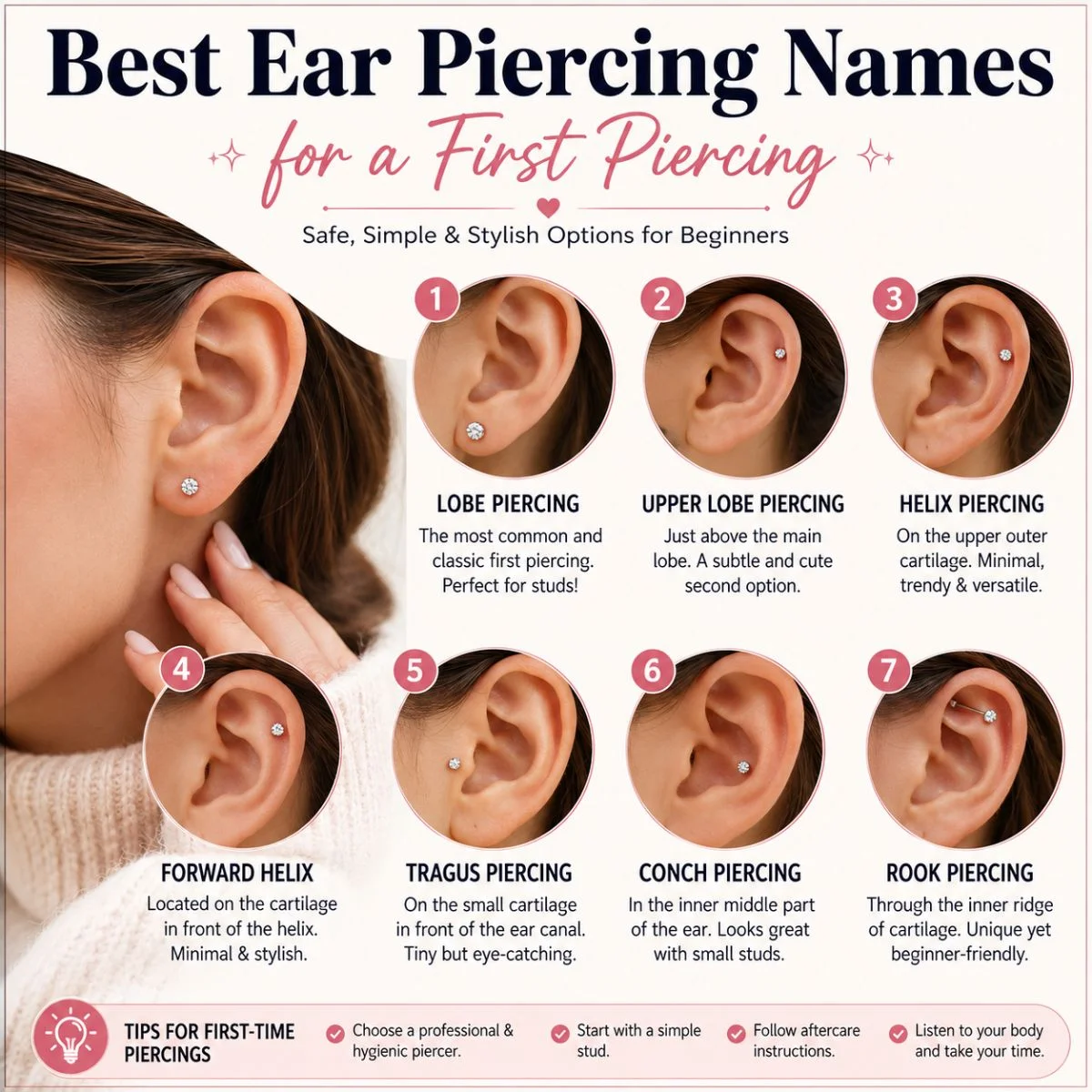
If you are getting your first piercing, the simplest option is usually the standard lobe. It is familiar, versatile, and easy to pair with different jewelry styles.
Good options to discuss with a professional include:
- Standard Lobe — A classic choice for someone who wants a straightforward first piercing.
- Upper Lobe — Works well if you already like the idea of a layered ear look.
- High Lobe — Adds a subtle change while staying close to the traditional lobe area.
- Helix — A popular choice if you specifically want visible cartilage jewelry.
Cartilage is not automatically unsuitable for beginners, but it typically requires more patience and careful attention to irritation. The Association of Professional Piercers advises leaving healing piercings alone except for cleaning, avoiding unnecessary rotation, and taking care around pressure and friction.
Popular Ear Piercing Names for a Curated Ear
A curated ear is less about choosing one “best” piercing and more about creating a balanced combination of placements and jewelry.
Popular combinations include:
- Double Lobe + Helix — A versatile arrangement that combines familiar lobe jewelry with one cartilage accent.
- Triple Lobe — Three coordinated lobe placements for a clean, layered appearance.
- Lobe + Forward Helix — Creates contrast between the lower and upper parts of the ear.
- Lobe + Conch + Helix — A balanced combination that distributes jewelry across different areas.
- Double Lobe + Tragus — A subtle arrangement with a small focal point near the ear canal.
- Lobe + Conch + Flat — Useful for a more jewelry-focused upper-ear composition.
- Helix + Forward Helix — Creates a concentrated cartilage look near the upper rim.
- Lobe + Daith + Helix — Combines lower, inner, and outer placements for a more adventurous setup.
The goal is not to fill every available space. A good arrangement considers spacing, anatomy, jewelry size, and how the pieces look together.
Cool Ear Piercing Names and Styles
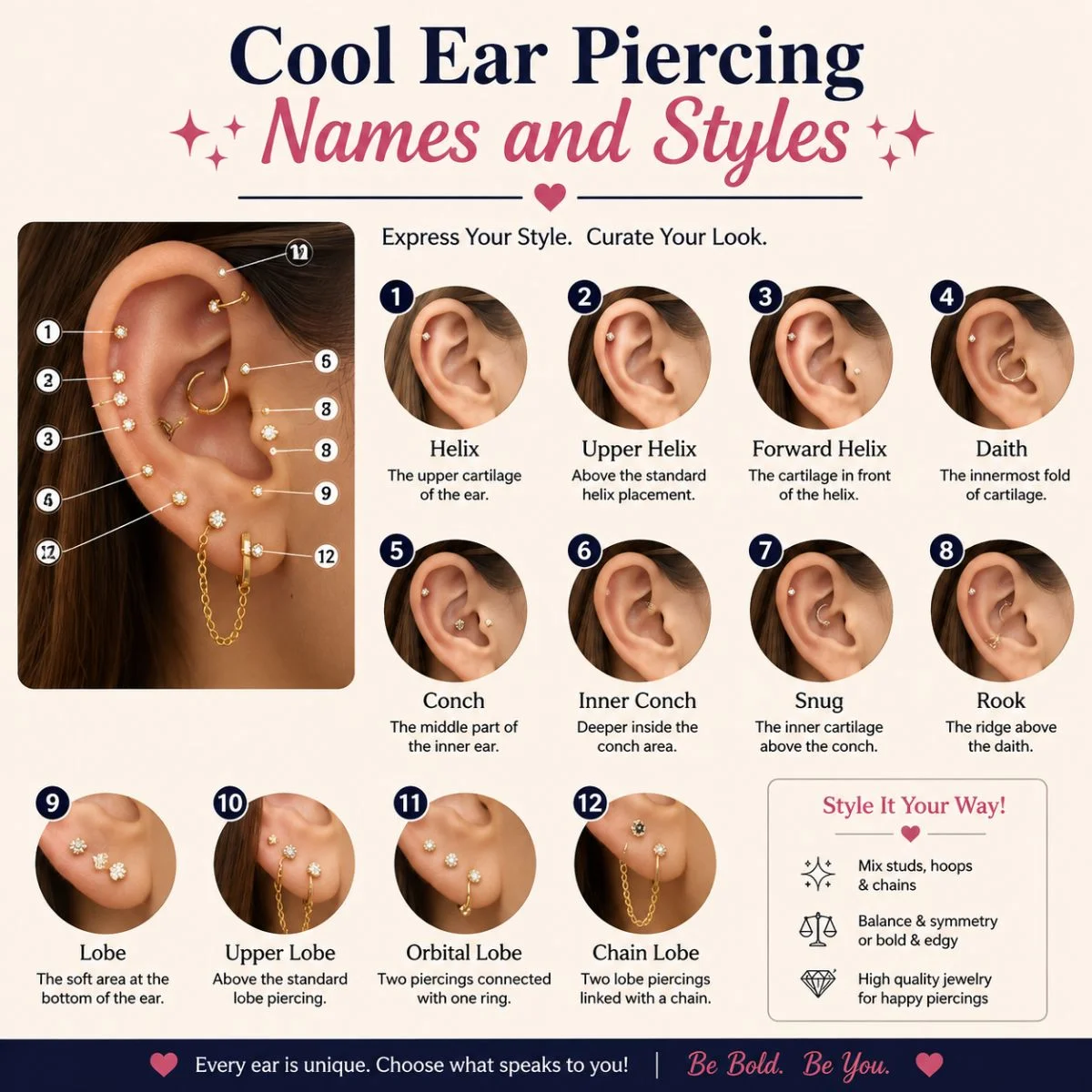
Some placements have a naturally bold or edgy appearance. Others become dramatic because of the jewelry selected.
If you want a stronger aesthetic, consider these names:
- Industrial — One of the most recognizable statement placements because a bar connects two points across the upper ear.
- Orbital — A creative two-hole configuration joined by a ring.
- Conch — Especially striking when styled with a larger hoop.
- Double Helix — Two helix placements can create a clean, coordinated row.
- Rook — A less immediately familiar placement that gives the inner ear a distinctive detail.
- Daith — A compact inner-ear placement that can work beautifully with a small ring.
- Snug — An unusual cartilage choice for people who prefer less conventional placements.
“Cool” ultimately depends on your jewelry and personal style. A tiny gold stud can make a cartilage piercing look understated, while a larger ring or coordinated stack can create a much bolder effect.
Cute and Minimal Ear Piercing Names
For a delicate look, small placements and lightweight jewelry usually create the cleanest result.
Consider:
- Upper Lobe — Subtle enough for everyday styling while adding another layer.
- Forward Helix — Small studs can give this placement a delicate appearance.
- Flat — Particularly suited to tiny decorative studs.
- Tragus — A small stud can create a neat accent without dominating the ear.
- Daith — A small ring can give the inner ear a soft focal point.
- Conch — A tiny stud offers a minimalist alternative to a larger conch hoop.
- Helix — A small hoop or stud can keep this popular placement understated.
Minimal styling is often easier to coordinate because each piece has room to stand out rather than competing for attention.
Ear Piercing Names for a Bold Look
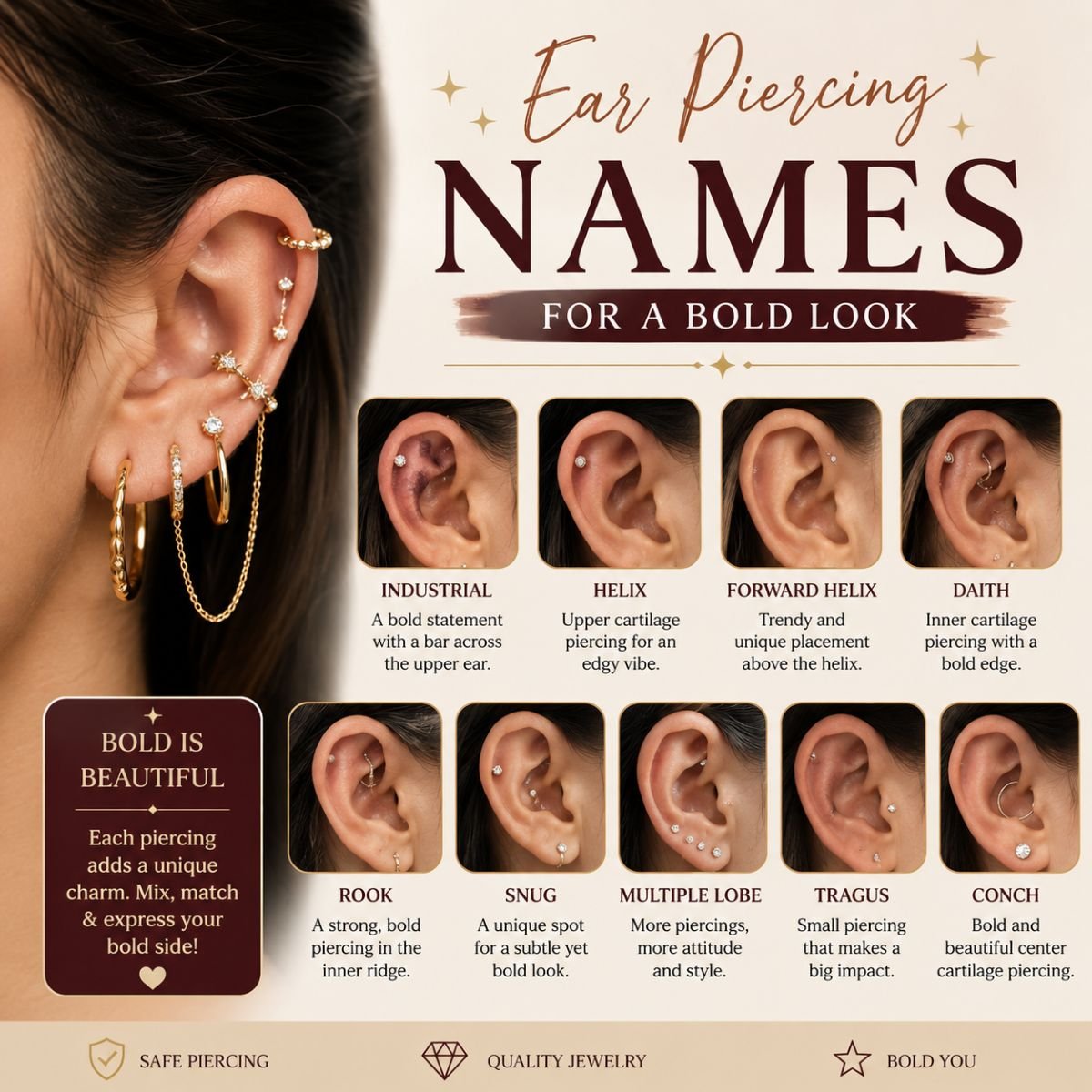
If you prefer statement jewelry or a more noticeable ear stack, some placements naturally create stronger visual impact.
- Industrial — The connecting bar makes it an immediate focal point.
- Conch — A hoop can create a strong circular shape in the center of the ear.
- Double or Triple Helix — Multiple upper-rim piercings create a layered effect.
- Orbital — The ring connecting two holes creates an unusual visual detail.
- Snug — Its less common location makes it stand out.
- Anti-Tragus — A distinctive choice for someone who wants something away from the usual lobe-and-helix combination.
Before choosing a bold placement, think about your daily routine. Headphones, helmets, hair styling, sleeping positions, and sports can all affect how easily a healing piercing gets irritated. The APP specifically notes that pressure on healing cartilage can contribute to irritation and changes in piercing angle.
Ear Piercing Names and Common Jewelry
Knowing the piercing name is only half the process. Jewelry needs to suit the location, anatomy, stage of healing, and intended look.
Common jewelry styles include:
- Studs — Simple and versatile, especially for lobe, helix, tragus, flat, and conch placements.
- Flat-back studs — Popular for placements where a low-profile backing is desirable.
- Hoops — Often used for lobes, helix, conch, and other healed placements where the anatomy and size allow.
- Barbells — Commonly associated with industrial piercings and some other placements.
- Curved barbells — Used in certain anatomy-specific placements, depending on the piercer’s assessment.
- Huggies — Small hoops that can create a close-fitting, understated look in suitable healed placements.
- Decorative ends — Gemstones, shapes, beads, and other ends can personalize a basic piercing.
For a fresh piercing, appearance should not be the only consideration. The APP notes that jewelry size, style, material, finish, and quality can affect healing, and recommends choosing jewelry appropriate for the specific placement rather than treating jewelry as purely decorative.
Which Ear Piercing Names Are Cartilage Piercings?
Most ear placements above the soft lobe involve cartilage.
Common cartilage piercing names include:
- Helix
- Forward Helix
- Flat
- Auricle
- Conch
- Tragus
- Anti-Tragus
- Daith
- Rook
- Snug
- Industrial
The important distinction is that cartilage is generally less forgiving of pressure and irritation than the soft lobe. Healing timelines vary considerably by placement and person, so published timelines should be treated as general guidance rather than a guarantee.
Ear Piercing Names by Style Personality
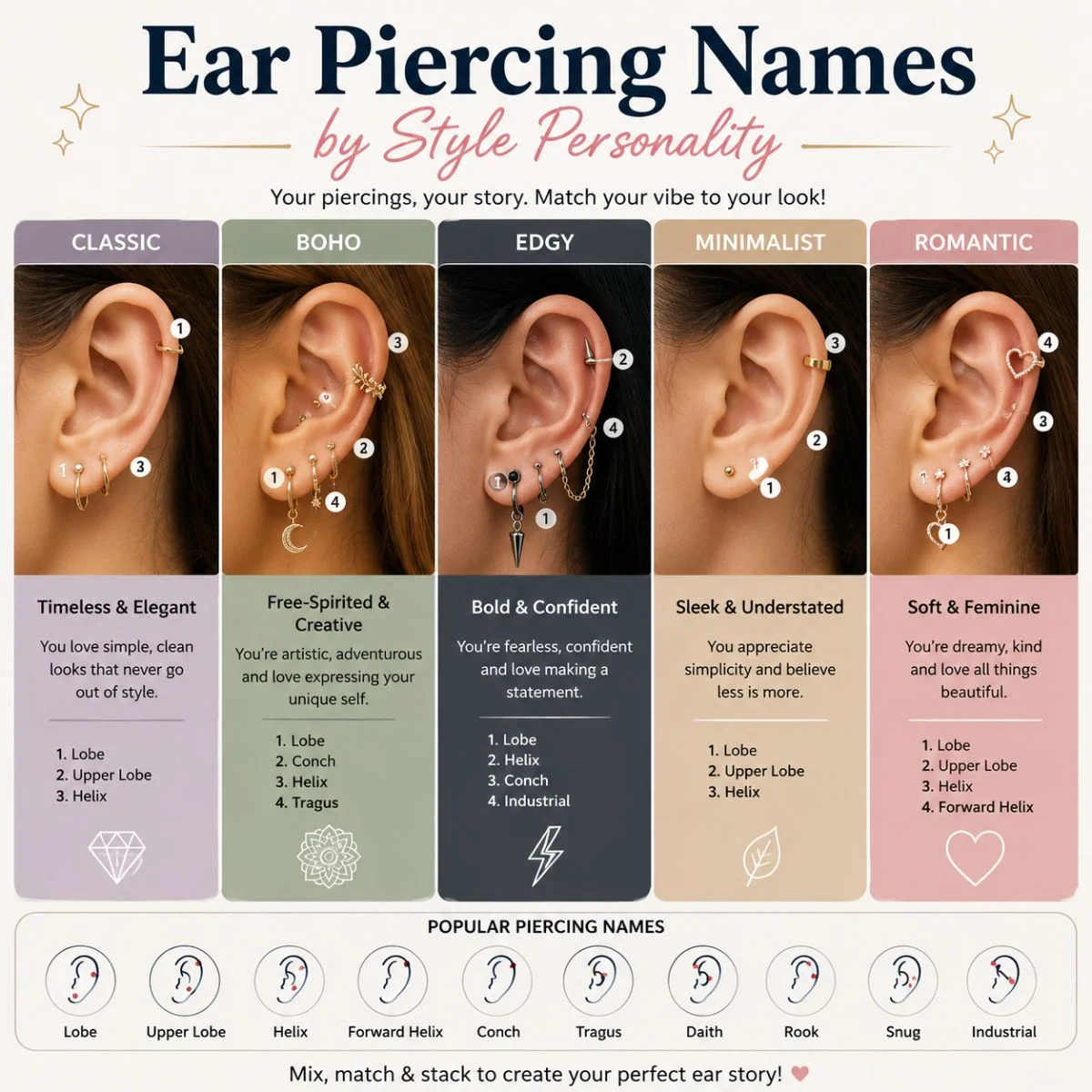
Your preferred aesthetic can also help narrow down the choices.
For a Classic Style
- Standard Lobe
- Upper Lobe
- Helix
- Conch
These placements can remain subtle and work with timeless jewelry.
For a Delicate Style
- Forward Helix
- Flat
- Tragus
- Upper Lobe
Small studs and restrained jewelry can keep the overall appearance refined.
For an Alternative Style
- Industrial
- Snug
- Anti-Tragus
- Orbital
These placements tend to feel less conventional and can become the centerpiece of a curated ear.
For a Balanced Curated Style
- Double Lobe
- Helix
- Conch
- Forward Helix
These options spread visual interest around the ear rather than concentrating everything in one location.
How to Choose the Right Ear Piercing
The most attractive placement on someone else may not be the best choice for your ear. Anatomy should come before aesthetics.
Consider Your Ear Anatomy
A professional piercer can examine the folds, thickness, spacing, and available tissue before recommending a placement. This matters particularly for piercings such as rook, snug, industrial, and forward helix.
The Association of Professional Piercers recommends that a piercer discuss anatomy, jewelry selection, potential risks, healing, and aftercare during a consultation.
Think About Your Lifestyle
Ask yourself how often you wear:
- Over-ear headphones
- Earbuds
- Helmets
- Hats
- Glasses
- Hair accessories
If an item regularly presses against the planned placement, healing may become more difficult.
Match the Jewelry to the Placement
Do not choose jewelry solely because you like its appearance. Fresh piercings need appropriately sized, high-quality jewelry designed for the placement. A professional piercer can help select the correct size and style.
Think About Your Sleeping Position
Side sleepers should pay particular attention to cartilage placements. Sleeping directly on a healing cartilage piercing can create irritation and pressure.
Plan the Whole Ear
If you want multiple piercings, consider the final layout before getting them all at once. Spacing, jewelry size, and healing requirements can affect whether the finished arrangement looks balanced.
How to Find the Ear Piercing Name You Want
If you have seen a piercing online but do not know its name, use its location as your starting point.
Ask yourself:
- Is it in the soft lower lobe?
- Is it along the outer upper rim?
- Is it toward the front of the upper ear?
- Is it in the central bowl?
- Is it on the small flap in front of the ear canal?
- Is it inside an upper cartilage fold?
- Does one piece of jewelry connect two holes?
For example, a piercing along the upper outer rim is likely a helix, while one in the central bowl is generally called a conch. A placement on the small flap directly in front of the ear canal is the tragus.
If the name is still unclear, showing your piercer a reference image is often more useful than relying on terminology alone.
What to Know Before Getting a New Ear Piercing
A piercing creates a wound, so choosing a clean, professional studio is just as important as choosing a style.
Look for a piercer who:
- Provides a consultation before piercing.
- Assesses your anatomy.
- Explains the procedure and potential risks.
- Uses sterile, appropriate equipment.
- Opens sterile packages in your presence.
- Provides clear aftercare instructions.
- Uses jewelry appropriate for fresh piercings.
- Maintains a clean, dedicated piercing environment.
The Association of Professional Piercers recommends checking the studio’s hygiene practices, sterilization procedures, disposable needles, jewelry quality, and aftercare guidance.
Avoid choosing a studio solely because it offers the cheapest price. Safe technique, suitable jewelry, and proper aftercare are more important than saving a small amount upfront.
Basic Ear Piercing Aftercare
Once you have chosen your placement, proper aftercare helps reduce unnecessary irritation.
The Association of Professional Piercers recommends washing your hands before touching a piercing, leaving it alone except when cleaning, avoiding twisting or rotating jewelry, and protecting healing piercings from unnecessary pressure.
Keep these principles in mind:
- Keep your hands clean before touching the area.
- Avoid twisting the jewelry during healing.
- Keep bedding and pillowcases clean, particularly for cartilage piercings.
- Avoid unnecessary pressure from headphones, helmets, or sleeping directly on the piercing.
- Keep cosmetics, lotions, and sprays away from the healing area.
- Avoid swimming or soaking the piercing while it is healing unless your piercer or healthcare professional advises otherwise.
- Do not change jewelry prematurely unless a qualified piercer recommends or performs the change.
A piercing can appear healed on the outside before the internal tissue has completely healed, so feeling better does not necessarily mean the healing process is finished.
When Should You Worry About a Piercing?
Some tenderness, swelling, itching, or light crusting can occur during normal healing. However, increasing heat, significant swelling, worsening pain, pus, or feeling generally unwell can indicate infection and should be taken seriously.
If you suspect an infection, seek medical advice promptly rather than trying to manage a serious infection yourself. The NHS advises leaving the jewelry in unless a doctor tells you to remove it.
Frequently Asked Questions
What are the most common ear piercing names?
The most commonly recognized names include standard lobe, upper lobe, helix, forward helix, flat, conch, tragus, daith, rook, snug, anti-tragus, and industrial. Different guides may include additional variations or configurations.
What is the easiest ear piercing to start with?
The standard lobe is commonly considered the simplest starting point because it passes through soft lobe tissue and accommodates many jewelry styles. Your individual anatomy and circumstances should still be considered before piercing.
What is the difference between a helix and a forward helix?
A helix is positioned along the upper outer cartilage rim. A forward helix sits farther toward the front of the upper ear, closer to the head.
What is a conch piercing?
A conch piercing is placed through the bowl-shaped cartilage in the central part of the ear. It can be styled with either a stud or, when appropriate for the anatomy and healing stage, a hoop.
What is the difference between a rook and a daith?
Both are inner-ear cartilage placements, but they occupy different folds. The daith sits through the innermost fold above the ear canal, while the rook sits through the cartilage ridge above it.
What is an industrial piercing?
An industrial piercing uses two separate piercing channels connected by one piece of jewelry, commonly a straight barbell. Because the alignment and anatomy need to work together, professional assessment is especially important.
Can everyone get every type of ear piercing?
No. Ear anatomy varies significantly, and some placements require specific folds, thickness, spacing, or angles. A professional piercer should assess your anatomy before confirming whether a particular piercing is appropriate.
How do I choose between different ear piercing names?
Start with the placement you like visually, then consider anatomy, lifestyle, jewelry, healing requirements, and how the piercing will fit with your existing or planned ear stack. A professional consultation can help turn the idea into a realistic placement.
Conclusion
Learning the different ear piercing names makes it much easier to understand your options and communicate what you want. From the classic standard lobe and versatile helix to distinctive placements such as the conch, rook, daith, snug, and industrial, each location creates a different look and has different practical considerations.
The best choice is not necessarily the trendiest piercing. Think about your ear anatomy, everyday routine, preferred jewelry, sleeping habits, and long-term styling goals. Most importantly, have a qualified professional assess the placement before getting pierced. With the right combination of anatomy, jewelry, and care, you can create an ear stack that feels personal rather than simply following a trend.

James Harrison is a dedicated name researcher and content writer at NamesCabin. He specializes in baby names, usernames, team names, gaming names, pet names, and name meanings. With a passion for language, culture, and creativity, James helps readers discover meaningful and memorable names through well-researched guides and expert insights.