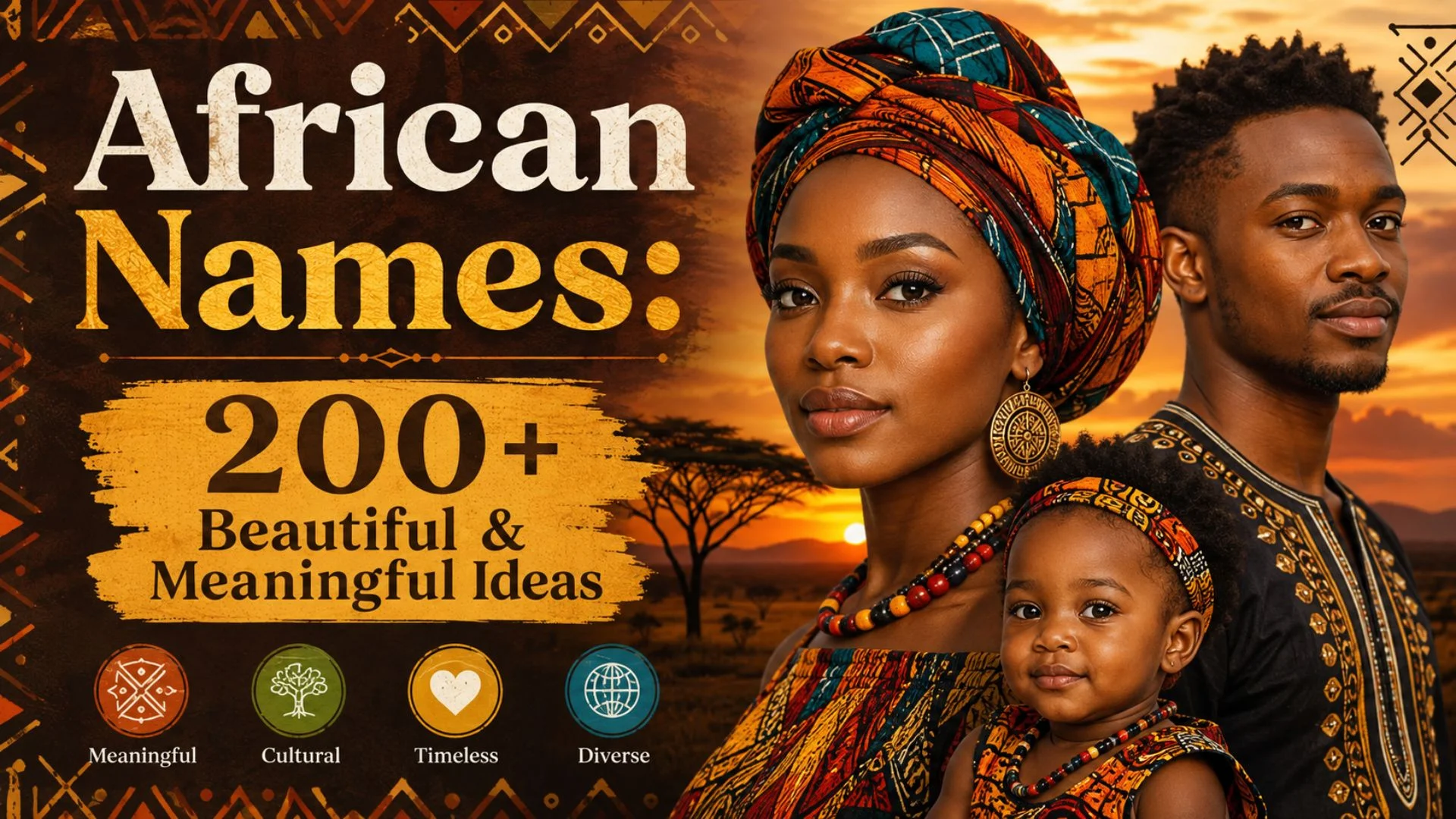
African names come from one of the world’s most linguistically and culturally diverse regions. Rather than representing one naming system, African names span hundreds of languages and traditions, including Yoruba, Igbo, Akan, Amharic, Swahili, Shona, Xhosa, and Zulu naming cultures. Names may describe a child’s birth circumstances, family position, hopes, qualities, faith, or the emotions surrounding their arrival.
That diversity makes African names especially appealing for parents, writers, gamers, and anyone searching for a name with genuine cultural depth. Below, you’ll find carefully selected names organized by language and style, with meanings and context where reliable sources provide them. Because “African” is a continental label rather than a single language or culture, identifying the specific origin of a name is an important part of choosing it respectfully.
Best African Names at a Glance
If you want a strong shortlist before exploring individual cultures, these names offer a range of sounds, meanings, and traditions.
- Amani — A Swahili-associated choice commonly connected with peace; a gentle, versatile option.
- Amara — An Igbo name meaning “grace,” with a polished, international sound.
- Abena — An Akan name meaning “born on Tuesday.”
- Ayo — A Yoruba name connected with “joy,” making it bright and concise.
- Chiamaka — An Igbo name meaning “God is more beautiful.”
- Desta — An Amharic name meaning “joy.”
- Farai — A Shona name associated with rejoicing and happiness.
- Luthando — A Xhosa name meaning “it is love.”
- Nia — A Swahili name meaning “purpose” or “aim.”
- Nyasha — A Shona name meaning “mercy.”
- Themba — A Zulu, Xhosa, and Ndebele name meaning “trust” or “hope.”
- Zola — A Xhosa name connected with calmness.
- Zuri — A Swahili name meaning “beautiful.”
African Names With Beautiful Meanings
Many African naming traditions place meaning at the heart of the name. A name may express joy, gratitude, love, strength, hope, beauty, family circumstances, or a spiritual belief. Yoruba names, for example, can record circumstances surrounding birth, while Akan names frequently identify the day of the week on which a child was born.
Here are some meaningful choices from different traditions:
- Abeni — Yoruba; “we prayed and we received.”
- Abiola — Yoruba; “born into wealth.”
- Abioye — Yoruba; “born into royalty.”
- Adedayo — Yoruba; “the crown becomes joy.”
- Adeola — Yoruba; “the crown of wealth.”
- Ayomide — Yoruba; “my joy has arrived.”
- Chiamaka — Igbo; “God is more beautiful.”
- Ebere — Igbo; “mercy” or “kindness.”
- Ekene — Igbo; “thanks” or “gratitude.”
- Ifeoma — Igbo; “good thing.”
- Desta — Amharic; “joy.”
- Bereket — Amharic; “blessing,” “abundance,” or “profusion.”
- Berhane — Amharic; “my light.”
- Neema — Swahili; “divine grace.”
- Nia — Swahili; “purpose” or “aim.”
- Nuru — Swahili; “light.”
- Chipo — Shona; “gift.”
- Rudo — Shona; “love.”
- Tariro — Shona; “hope.”
- Rutendo — Shona; “thankfulness.”
- Thandiwe — Xhosa, Zulu, and Ndebele; “loving one.”
- Zanele — Zulu and Xhosa; “they are enough.”
African Girl Names
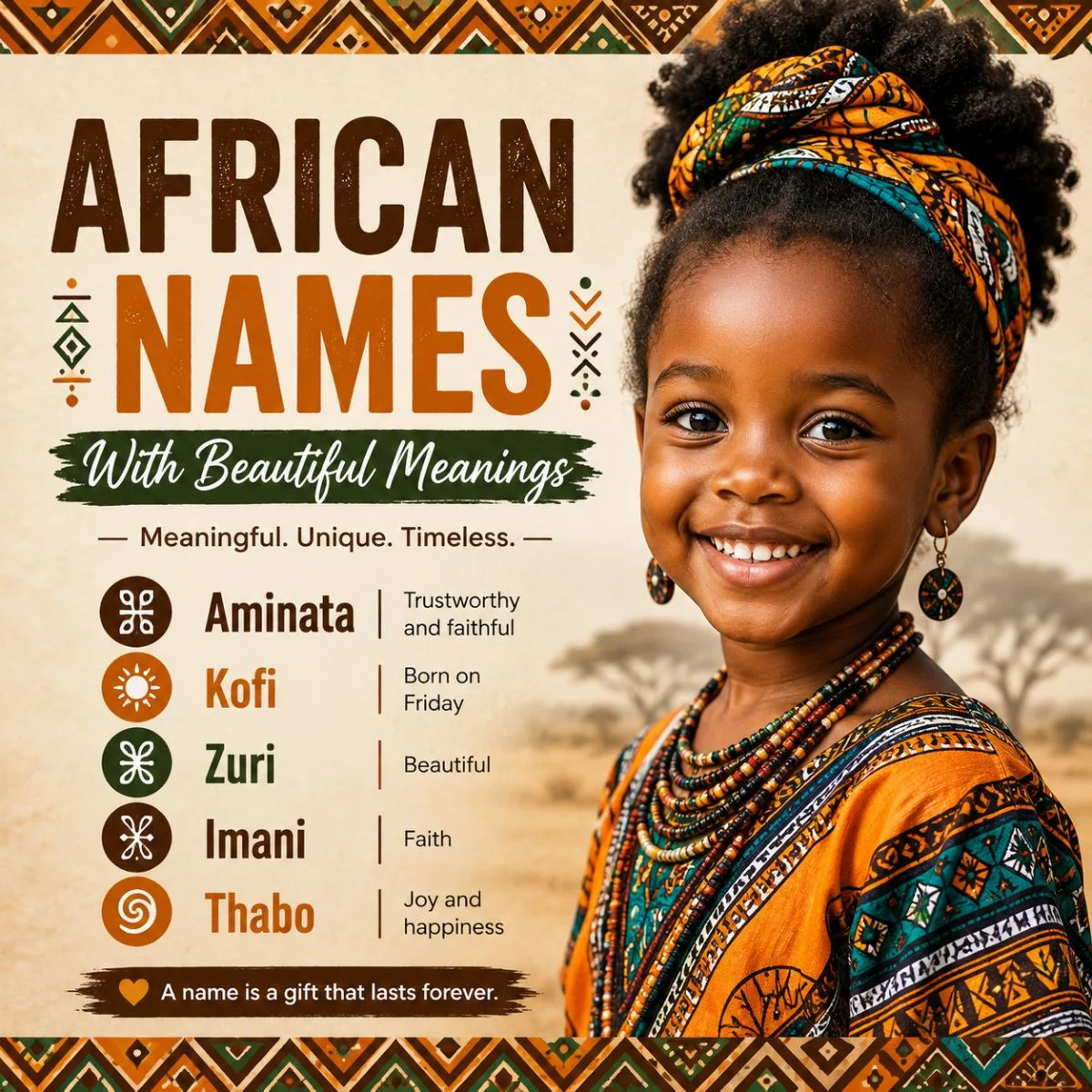
African girl names range from short, lyrical choices to longer names with detailed family or spiritual meanings. If you want something feminine without losing cultural specificity, consider the language attached to each name rather than treating every African name as interchangeable.
- Abeni — Yoruba; associated with receiving an answered prayer.
- Abimbola — Yoruba; “born to me with wealth.”
- Adenike — Yoruba; “the crown is to be cared for.”
- Aderonke — Yoruba; “the crown has found something to cherish.”
- Bolanle — Yoruba; “find wealth at home.”
- Adaeze — Igbo; “eldest daughter of the king.”
- Adanna — Igbo; “eldest daughter of the father.”
- Amaka — Igbo; a short form of Chiamaka.
- Amarachi — Igbo; “God’s grace.”
- Anuli — Igbo; “joy.”
- Abeba — Amharic; the feminine form of Abebe, a name derived from a word meaning “flower.”
- Aberash — Amharic; “giving off light” or “shining.”
- Almaz — Used in Amharic and other languages; associated with “diamond.”
- Etenesh — Amharic; “you are my sister.”
- Akosua — Akan; “born on Sunday.”
- Afua — Akan; “born on Friday.”
- Akua — Akan; “born on Wednesday.”
- Ama — Akan; “born on Saturday.”
- Yaa — Akan; “born on Thursday.”
- Neema — Swahili; “divine grace.”
- Pendo — Swahili; a variant of Upendo, associated with love.
- Zuri — Swahili; “beautiful.”
- Nyasha — Shona; “mercy.”
- Rufaro — Shona; “happiness.”
- Rumbidzai — Shona; associated with praise.
- Sekai — Shona; associated with laughing.
- Nkosazana — Xhosa; “princess.”
- Thobeka — Xhosa; “to be humble.”
- Lindiwe — Zulu, Xhosa, Ndebele, and Swazi; “waited for” or “awaited.”
- Nosipho — Zulu and Xhosa; formed with a feminine prefix and a word meaning “gift.”
African Boy Names
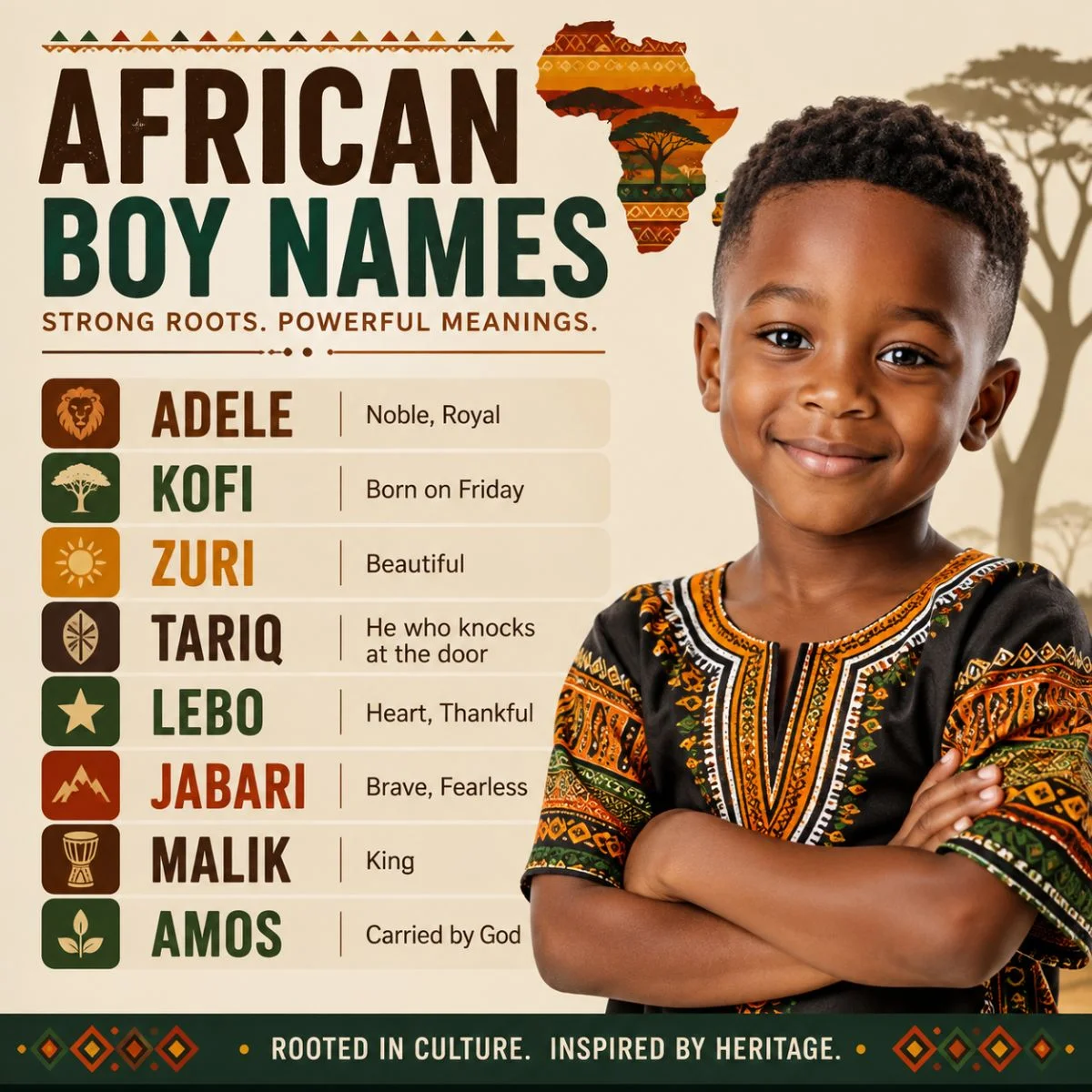
For boys, African naming traditions offer everything from compact names such as Ayo and Kofi to longer names whose meanings preserve family stories or aspirations.
- Adebayo — Yoruba; “the crown meets joy.”
- Adegoke — Yoruba; “the crown has ascended the mountain.”
- Adekunle — Yoruba; “the crown has filled the home.”
- Adewale — Yoruba; “the crown has come home.”
- Afolabi — Yoruba; “born into wealth.”
- Ayodele — Yoruba; “joy has come home.”
- Ayokunle — Yoruba; “joy has filled the home.”
- Babatunde — Yoruba; “father has come again.”
- Azubuike — Igbo; “the past is your strength” or “your back is your strength.”
- Chibueze — Igbo; “God is the king.”
- Chibuike — Igbo; “God is strength.”
- Chukwuebuka — Igbo; “God is greater.”
- Ejike — Igbo; “one having strength.”
- Ifeanyi — Igbo; “we can do anything.”
- Abebe — Amharic; derived from a word meaning “flower.”
- Ayele — Amharic; “become strong” or “become powerful.”
- Bekele — Amharic; “grow” or “flourish.”
- Dejen — Amharic; “foundation” or “support.”
- Girma — Amharic; “majesty.”
- Kofi — Akan; “born on Friday.”
- Kwame — Akan; “born on Saturday.”
- Kwaku — Akan; “born on Wednesday.”
- Kwabena — Akan; “born on Tuesday.”
- Yaw — Akan; “born on Thursday.”
- Mosi — Swahili; “first child.”
- Nuhu — Hausa and Swahili form of Noah.
- Themba — Zulu, Xhosa, and Ndebele; “trust” or “hope.”
- Melisizwe — Xhosa; “leader of the nation.”
- Nkosana — Xhosa; “prince.”
- Sizwe — Xhosa; “nation.”
Gender-Neutral African Names
Some African names are explicitly recorded as masculine and feminine, while others are used across genders depending on the language and community. That makes them useful choices if you want a flexible name, but the exact gender usage should always be checked within its specific cultural context.
- Abidemi — Yoruba; “born in my absence.”
- Abimbola — Yoruba; “born to me with wealth.”
- Abiodun — Yoruba; “born on a festival.”
- Abioye — Yoruba; “born into royalty.”
- Ade — Yoruba; from adé, meaning “crown.”
- Ayomide — Yoruba; “my joy has arrived.”
- Chibuzo — Igbo; “God is the way.”
- Ekene — Igbo; “thanks” or “gratitude.”
- Desta — Amharic; “joy.”
- Berhane — Amharic; “my light.”
- Farai — Shona; “rejoice” or “be happy.”
- Fungai — Shona; associated with thinking or judging.
- Mudiwa — Shona; “beloved” or “darling.”
- Munashe — Shona; “with God.”
- Rutendo — Shona; “thankfulness.”
- Tafadzwa — Shona; “we are pleased.”
- Tinashe — Shona; “we are with God.”
- Luthando — Xhosa; “it is love.”
- Lwandle — Zulu and Xhosa; “ocean.”
- Melokuhle — Zulu and Xhosa; connected with standing for goodness.
- Thando — Xhosa, Zulu, and Ndebele; connected with love.
- Zanokuhle — Zulu and Xhosa; “come with goodness.”
- Zola — Xhosa; connected with calmness.
Short African Names
Short names can be especially appealing when you want something easy to pronounce, spell, and remember. Several African languages offer compact names with substantial meanings, proving that a brief name does not have to feel ordinary.
- Ade — Yoruba; “crown.”
- Ayo — Yoruba; “joy.”
- Ama — Akan; “born on Saturday.”
- Yaa — Akan; “born on Thursday.”
- Kofi — Akan; “born on Friday.”
- Kojo — Akan; a variant of Kwadwo, “born on Monday.”
- Mosi — Swahili; “first child.”
- Nia — Swahili; “purpose” or “aim.”
- Nuru — Swahili; “light.”
- Zuri — Swahili; “beautiful.”
- Rudo — Shona; “love.”
- Tariro — Shona; “hope.”
- Thandi — Xhosa, Zulu, and Ndebele; a short form of Thandiwe.
- Thando — Xhosa, Zulu, and Ndebele; connected with love.
- Zola — Xhosa; connected with calmness.
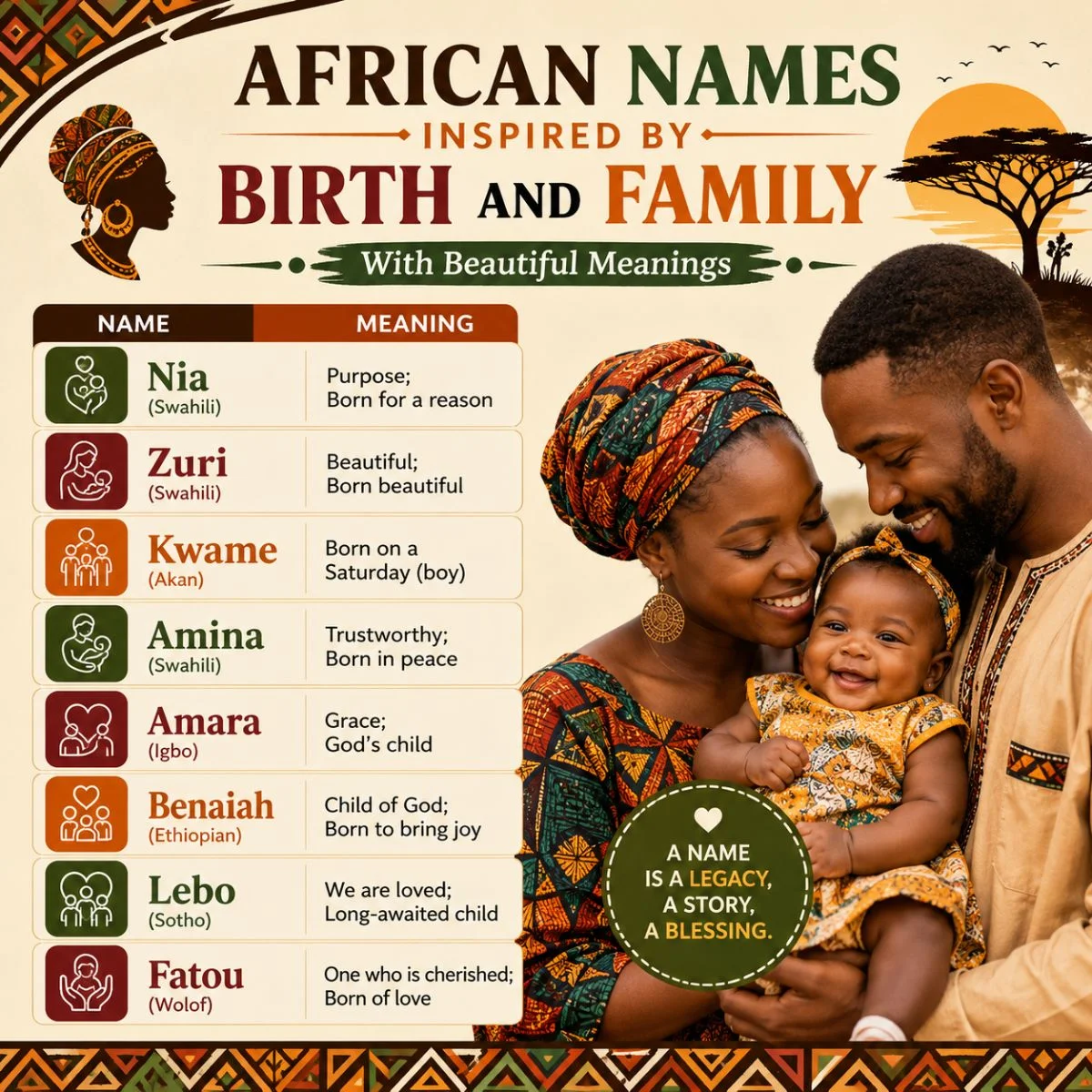
African Names Inspired by Birth and Family
One of the most interesting features of African naming traditions is the way names can preserve the story of a child’s arrival. Behind the Name notes that traditional African given names may refer to the day or time of birth, birth order, being a twin, circumstances surrounding the parents, or qualities desired for the child.
Day-of-the-Week Names
Akan naming traditions provide especially clear examples of names connected with the day of birth.
- Adwoa — Akan; born on Monday.
- Kwabena — Akan; born on Tuesday.
- Akua — Akan; born on Wednesday.
- Yaw — Akan; born on Thursday.
- Kofi — Akan; born on Friday.
- Ama — Akan; born on Saturday.
- Akosua — Akan; born on Sunday.
Swahili also has names that record the day or occasion surrounding birth.
- Mwanajuma — Swahili; “child born on Friday.”
- Mwanahamisi — Swahili; “child born on Thursday.”
- Mwanaidi — Swahili; “child born during the festival.”
Birth-Order Names
Family position can also become part of a child’s name.
- Baako — Akan; “first born child.”
- Anan — Akan; “fourth born child.”
- Enu — Akan; “fifth born child.”
- Nsia — Akan; “sixth born child.”
- Nsonowa — Akan; “seventh born child.”
- Awotwi — Akan; “eighth born child.”
- Nkruma — Akan; “ninth born child.”
- Dubaku — Akan; “eleventh born child.”
- Alaba — Yoruba; “second child after twins.”
- Pili — Swahili; “second child.”
Strong African Names
A strong name does not have to sound aggressive. Strength can be expressed through power, leadership, resilience, hope, support, or the idea of overcoming difficulty.
- Ayele — Amharic; “become strong” or “become powerful.”
- Azubuike — Igbo; associated with strength found in the past or one’s support.
- Chibuike — Igbo; “God is strength.”
- Ejike — Igbo; “one having strength.”
- Dejen — Amharic; “foundation” or “support.”
- Girma — Amharic; “majesty.”
- Themba — Zulu, Xhosa, and Ndebele; “trust” or “hope.”
- Melisizwe — Xhosa; “leader of the nation.”
- Nkosana — Xhosa; “prince.”
- Sizwe — Xhosa; “nation.”
- Thamsanqa — Xhosa and Zulu; “luck” or “fortune.”
- Nonkululeko — Zulu and Xhosa; connected with “freedom.”
African Names Connected With Love, Joy, and Hope
If you want a name with a warm emotional meaning, several African languages offer beautiful choices centered on affection, happiness, gratitude, and optimism.
- Ayo — Yoruba; “joy.”
- Ayodele — Yoruba; “joy has come home.”
- Ayomide — Yoruba; “my joy has arrived.”
- Ayotunde — Yoruba; “joy has come again.”
- Anuli — Igbo; “joy.”
- Desta — Amharic; “joy.”
- Farai — Shona; “rejoice” or “be happy.”
- Mudiwa — Shona; “beloved” or “darling.”
- Rudo — Shona; “love.”
- Rufaro — Shona; “happiness.”
- Tariro — Shona; “hope.”
- Thandiwe — Xhosa, Zulu, and Ndebele; “loving one.”
- Thando — Xhosa, Zulu, and Ndebele; connected with love.
- Thandolwethu — Xhosa, Zulu, Ndebele, and Swazi; “our love.”
- Luthando — Xhosa; “it is love.”
- Themba — Zulu, Xhosa, and Ndebele; “trust” or “hope.”
African Names Inspired by Nature and Light
Nature is another recurring source of African names. The wider naming landscape includes references to flowers, oceans, light, beauty, and other elements of the natural world.
- Abebe — Amharic; derived from a word meaning “flower.”
- Abeba — Amharic; feminine form of Abebe.
- Almaz — Used in Amharic and other languages; associated with “diamond.”
- Berhane — Amharic; “my light.”
- Berhanu — Amharic; “his light.”
- Nuru — Swahili; “light.”
- Lwandle — Zulu and Xhosa; “ocean.”
- Lisakhanya — Xhosa and Zulu; “still shining.”
- Zola — Xhosa; connected with calmness.
- Zuri — Swahili; “beautiful.”
- Melokuhle — Zulu and Xhosa; associated with standing for goodness.
- Okuhle — Zulu and Xhosa; “that which is beautiful” or “that which is good.”
African Names by Cultural and Language Origin
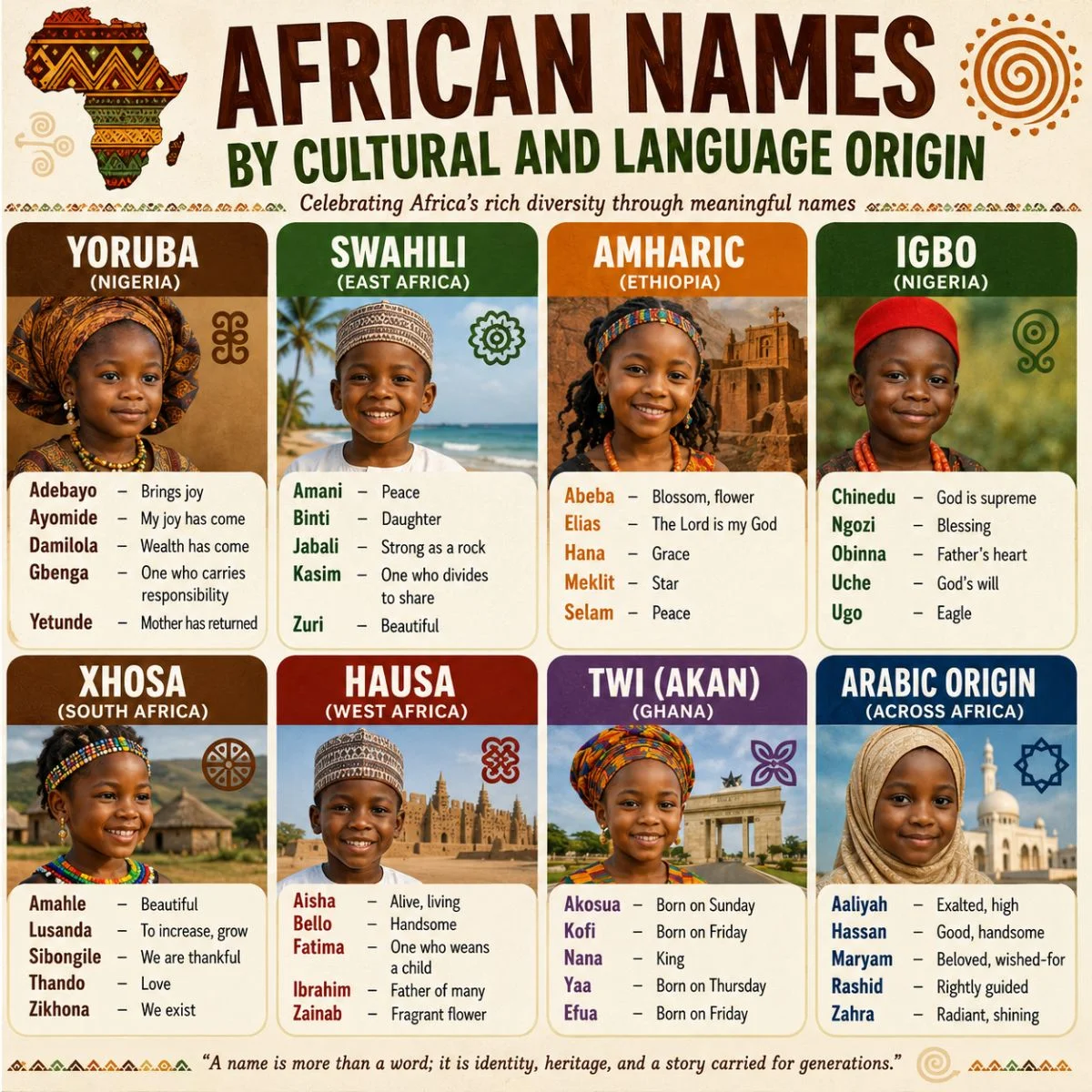
Choosing by language is often more meaningful than simply searching for a generic “African” name. Africa contains hundreds of languages and more than a thousand ethnic groups, so a Yoruba name, an Akan name, and an Amharic name belong to very different cultural and linguistic contexts.
Yoruba Names
Yoruba names are associated primarily with the Yoruba people of Nigeria. Many traditional names communicate birth circumstances, family hopes, wealth, joy, royalty, or the role of the crown.
- Abeni — We prayed and we received.
- Abiola — Born into wealth.
- Abioye — Born into royalty.
- Adebayo — The crown meets joy.
- Adebola — The crown meets wealth.
- Adebowale — The crown has returned home.
- Adedayo — The crown becomes joy.
- Adekunle — The crown has filled the home.
- Ademola — The crown is with wealth.
- Adeola — The crown of wealth.
- Adewale — The crown has come home.
- Ayodele — Joy has come home.
- Ayomide — My joy has arrived.
- Ayotunde — Joy has come again.
- Babatunde — Father has come again.
Igbo Names
Igbo naming traditions include names expressing grace, joy, gratitude, family position, strength, and religious belief. Some names beginning with Chi relate to the Igbo concept of a personal spiritual guardian.
- Adaeze — Eldest daughter of the king.
- Adanna — Eldest daughter of the father.
- Akachi — The hand of God.
- Akuchi — Wealth from God.
- Amara — Grace.
- Amarachi — God’s grace.
- Anuli — Joy.
- Chiamaka — God is more beautiful.
- Chibueze — God is the king.
- Chibuike — God is strength.
- Chibuzo — God is the way.
- Chukwuebuka — God is greater.
- Ebere — Mercy or kindness.
- Ekene — Thanks or gratitude.
- Ifeoma — Good thing.
Akan Names
Akan names from Ghana and Ivory Coast are particularly interesting because many traditional given names identify the day on which a child was born.
- Adwoa — Born on Monday.
- Abena — Born on Tuesday.
- Akua — Born on Wednesday.
- Yaa — Born on Thursday.
- Afua — Born on Friday.
- Ama — Born on Saturday.
- Akosua — Born on Sunday.
- Kwadwo — Born on Monday.
- Kwabena — Born on Tuesday.
- Kwaku — Born on Wednesday.
- Yaw — Born on Thursday.
- Kofi — Born on Friday.
- Kwame — Born on Saturday.
- Kwasi — Born on Sunday.
- Nana — An Akan title associated with a monarch.
Amharic Names
Amharic names are used in Ethiopia and include choices associated with flowers, light, strength, growth, joy, blessing, and majesty.
- Abebe — Flower.
- Abeba — Feminine form of Abebe.
- Abera — Shine, illuminate, or burn.
- Aberash — Giving off light or shining.
- Ayele — Become strong or powerful.
- Bekele — Grow or flourish.
- Bereket — Blessing or abundance.
- Berhane — My light.
- Berhanu — His light.
- Dejen — Foundation or support.
- Desta — Joy.
- Girma — Majesty.
- Almaz — Diamond.
- Alemu — Derived from a word meaning world.
Swahili Names
Swahili names offer many compact choices and include meanings connected with purpose, beauty, light, grace, birth order, and family circumstances.
- Mosi — First child.
- Mwanajuma — Child born on Friday.
- Mwanahamisi — Child born on Thursday.
- Neema — Divine grace.
- Nia — Purpose or aim.
- Nuru — Light.
- Pendo — Variant of Upendo.
- Pili — Second child.
- Zuri — Beautiful.
- Nuhu — Swahili form of Noah.
- Mwanaisha — A combination involving mwana, “child,” and Aisha.
- Mwanaidi — Child born during the festival.
Shona Names
Shona names from Zimbabwe include many expressive word names. Themes such as happiness, love, mercy, gratitude, hope, praise, and faith appear throughout the naming tradition.
- Chipo — Gift.
- Dakarai — Rejoice.
- Farai — Rejoice or be happy.
- Fungai — Think or judge.
- Itai — Do, act, or perform.
- Mudiwa — Beloved or darling.
- Munashe — With God.
- Nyasha — Mercy.
- Rudo — Love.
- Rufaro — Happiness.
- Rumbidzai — Praise.
- Rutendo — Thankfulness.
- Tafadzwa — We are pleased.
- Tariro — Hope.
- Tatenda — Thank you.
- Tinashe — We are with God.
- Tsitsi — Mercy or compassion.
Xhosa and Zulu Names
Southern African naming traditions include many names that express love, beauty, goodness, hope, family, freedom, and belonging. Several names are used across Xhosa and Zulu, while others belong more specifically to one language.
- Andile — They have increased.
- Ayanda — They are increasing.
- Banele — It is enough.
- Buhle — Beautiful or handsome.
- Busisiwe — Blessed.
- Lindiwe — Waited for or awaited.
- Luthando — It is love.
- Lwandle — Ocean.
- Nkosana — Prince.
- Nkosazana — Princess.
- Nonkululeko — Freedom.
- Nosipho — Gift.
- Noxolo — Peace.
- Themba — Trust or hope.
- Thandiwe — Loving one.
- Thando — Love.
- Zanele — They are enough.
- Zanokuhle — Come with goodness.
- Zola — Calm.
How to Choose the Right African Name
The best African name is not necessarily the rarest or longest. Start with the meaning and cultural origin, then decide whether the sound and spelling work for your situation.
1. Choose a specific cultural origin
Instead of stopping at “African,” decide whether you are drawn to Yoruba, Igbo, Akan, Amharic, Swahili, Shona, Xhosa, Zulu, or another tradition. This gives the name a clearer cultural context.
2. Verify the meaning
Online name lists sometimes attach uncertain meanings to names. Reliable references can disagree, especially when a name crosses languages or has multiple spellings. For example, some databases explicitly mark particular etymologies as uncertain.
If cultural authenticity matters to you, prioritize a source that identifies the language and explains the meaning rather than relying on a generic “African name” label.
3. Consider pronunciation
Say the name aloud several times. Think about how it sounds with the family name and whether the pronunciation will remain comfortable in the community where the person will live.
4. Look beyond literal meaning
A name such as Themba, associated with trust and hope, may appeal because of the values it represents. Likewise, Tariro, meaning hope in Shona, carries an emotional idea that can matter more than how unusual the name looks on paper.
5. Respect the culture behind the name
If you are choosing a name from a culture outside your own, learn what the name means within that culture. Avoid treating an African language as a collection of aesthetic sounds. The history, pronunciation, and community attached to a name are part of what makes it meaningful.
6. Think about long-term usability
For a baby name, consider how it will sound at different ages. For a character, username, or creative project, think about whether the name immediately communicates the personality you want.
African Names for Characters, Stories, and Creative Projects
African names can also work beautifully for fictional characters, especially when the character’s background is tied to the culture represented by the name. The most convincing approach is to choose a specific linguistic tradition first.
For example:
- Adebayo — Works well for a character whose story emphasizes joy, royalty, or family heritage.
- Chiamaka — A meaningful choice for a character associated with beauty or faith.
- Desta — Suits a joyful character and has a concise, memorable sound.
- Nia — A natural fit for a character whose story centers on purpose or determination.
- Tariro — A strong option for a hopeful or resilient character.
- Themba — Fits a character whose role involves hope, trust, or leadership.
- Luthando — A fitting choice for a character whose story revolves around love.
- Zola — Useful for a calm, composed character.
Frequently Asked Questions
What are some beautiful African names?
Beautiful options include Zuri, Amara, Chiamaka, Desta, Nia, Luthando, Thandiwe, and Abeni. Their appeal comes not only from their sound but also from meanings such as beauty, grace, joy, purpose, love, and answered prayer.
What is the most popular African name?
There is no single “most popular African name” because Africa contains many countries, languages, and naming cultures. Popularity also changes by country and by the population being measured. A name that is familiar in Nigeria may not have the same standing in Ethiopia, Ghana, Kenya, Zimbabwe, or South Africa.
What African names mean love?
Several names have direct or close connections to love. Rudo means “love” in Shona, Luthando means “it is love” in Xhosa, Thando is connected with love in Xhosa, Zulu, and Ndebele, and Thandolwethu means “our love.”
What African names mean joy?
Ayo is connected with “joy” in Yoruba, while Ayomide means “my joy has arrived.” Desta means “joy” in Amharic, and Anuli means “joy” in Igbo. Shona also has Farai, associated with rejoicing and happiness.
Are African names gender-neutral?
Yes. Some African names are explicitly recorded as masculine and feminine or are used across genders within particular languages. Examples include Abidemi, Ayomide, Ekene, Farai, Munashe, Luthando, Unathi, and Thando. However, gender usage can vary by community, so the cultural context matters.
Why do some African names relate to the day a child was born?
In several African naming traditions, a child’s birth day or circumstances can influence their given name. Akan names are a well-known example, with names such as Kofi for a Friday-born child and Kwame for a Saturday-born child. Swahili also includes names referring to particular birth days or occasions.
How do I choose an authentic African name?
Start by identifying the specific language or cultural tradition. Then verify the name’s meaning, pronunciation, and usage with a reliable linguistic or cultural reference. This approach is much more respectful and accurate than choosing a name solely because it “sounds African.”
Can I use an African name for a fictional character?
Yes, but research the name’s cultural background first. A character becomes more convincing when the name matches their fictional heritage, language, family context, and story rather than serving as a generic symbol of Africa.
Conclusion
African names offer far more than distinctive sounds. They can preserve birth stories, family relationships, faith, hopes, values, nature, and cultural identity. From Yoruba names built around the ideas of crown and joy to Akan day names, Igbo expressions of grace and strength, Amharic names associated with light and flourishing, Shona names centered on love and hope, and Xhosa and Zulu names expressing belonging and goodness, each tradition brings its own character.
When choosing among African names, focus first on cultural origin and meaning, then consider pronunciation, memorability, and long-term fit. A name becomes especially meaningful when you understand the language and story behind it—not simply because it sounds beautiful.

James Harrison is a dedicated name researcher and content writer at NamesCabin. He specializes in baby names, usernames, team names, gaming names, pet names, and name meanings. With a passion for language, culture, and creativity, James helps readers discover meaningful and memorable names through well-researched guides and expert insights.